the atomic symbol $_{82}^{206}pb$ represents lead - 206 (pb - 206), an isotope that has 82 protons and 124…
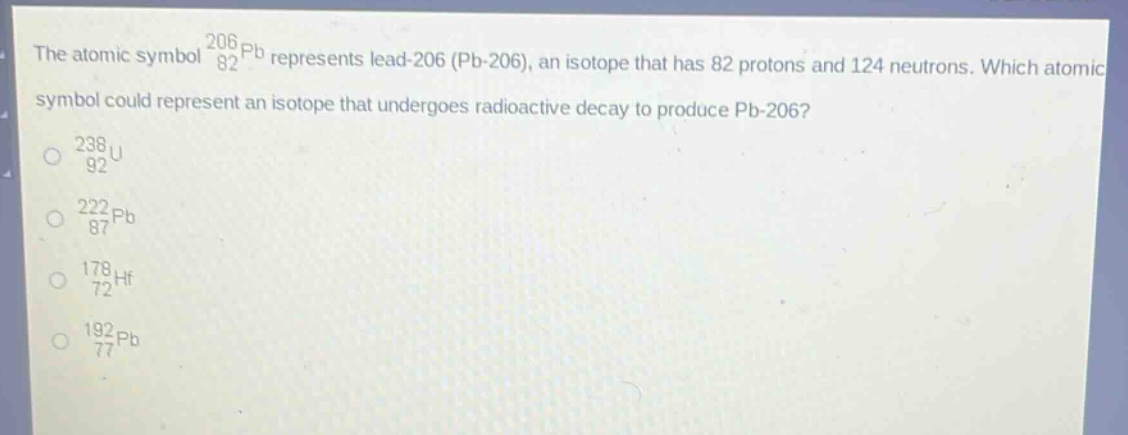
the atomic symbol $_{82}^{206}pb$ represents lead - 206 (pb - 206), an isotope that has 82 protons and 124 neutrons. which atomic symbol could represent an isotope that undergoes radioactive decay to produce pb - 206?\n$_{92}^{238}u$\n$_{87}^{222}pb$\n$_{72}^{178}hf$\n$_{77}^{192}pb$
Answer
Explanation:
Step1: Recall radioactive - decay principles
In radioactive decay, the total number of protons and neutrons (mass number) and the number of protons (atomic number) change according to specific decay processes. For an isotope to decay into lead - 206 ($^{206}_{82}$Pb) with 82 protons and 206 mass number, the parent isotope should have a higher mass number and an appropriate atomic number.
Step2: Analyze each option
- Option 1: $^{238}_{92}$U has an atomic number of 92 and a mass number of 238. Uranium - 238 can undergo a series of alpha and beta decays to eventually form lead - 206. An alpha decay reduces the mass number by 4 and the atomic number by 2, and a beta decay increases the atomic number by 1 while the mass number remains the same.
- Option 2: $^{222}_{87}$Pb is incorrect because the atomic number of lead is 82, not 87. This is not a valid lead isotope.
- Option 3: $^{178}_{72}$Hf has an atomic number of 72 and a mass number of 178. It is a hafnium isotope and is far from the atomic and mass numbers required to decay into lead - 206.
- Option 4: $^{192}_{77}$Pb is incorrect because the atomic number of lead is 82, not 77. This is not a valid lead isotope.
Answer:
$^{238}_{92}$U