atoms of elements at the top of a group on the periodic table are smaller than the atoms of elements at the…
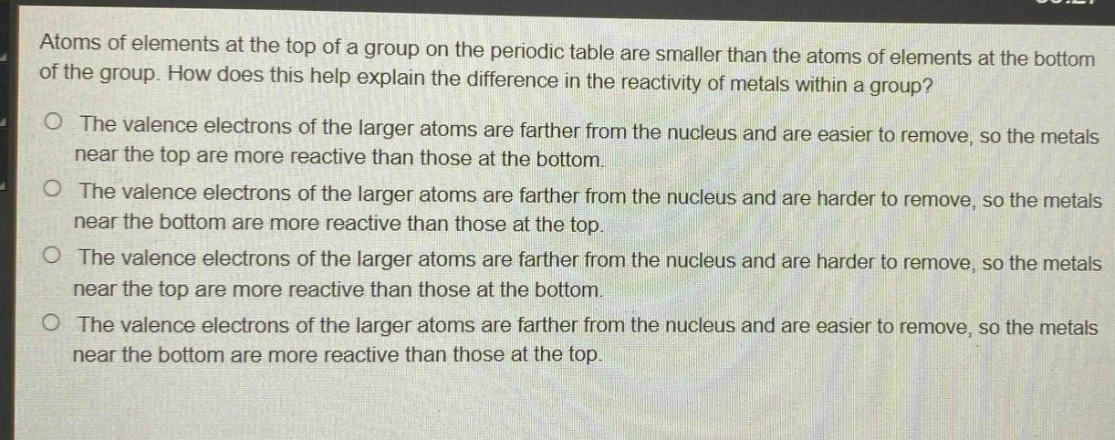
atoms of elements at the top of a group on the periodic table are smaller than the atoms of elements at the bottom of the group. how does this help explain the difference in the reactivity of metals within a group?\no the valence electrons of the larger atoms are farther from the nucleus and are easier to remove, so the metals near the top are more reactive than those at the bottom.\no the valence electrons of the larger atoms are farther from the nucleus and are harder to remove, so the metals near the bottom are more reactive than those at the top.\no the valence electrons of the larger atoms are farther from the nucleus and are harder to remove, so the metals near the top are more reactive than those at the bottom.\no the valence electrons of the larger atoms are farther from the nucleus and are easier to remove, so the metals near the bottom are more reactive than those at the top.
Answer
Brief Explanations:
Reactivity of metals depends on ease of losing valence - electrons. Larger atoms at the bottom of a group have valence - electrons farther from the nucleus. The attraction between the nucleus and these electrons is weaker, making them easier to remove. So, metals at the bottom are more reactive.
Answer:
The valence electrons of the larger atoms are farther from the nucleus and are easier to remove, so the metals near the bottom are more reactive than those at the top.