some atoms have an unequal number of protons and electrons, which gives the atom a positive or negative net…
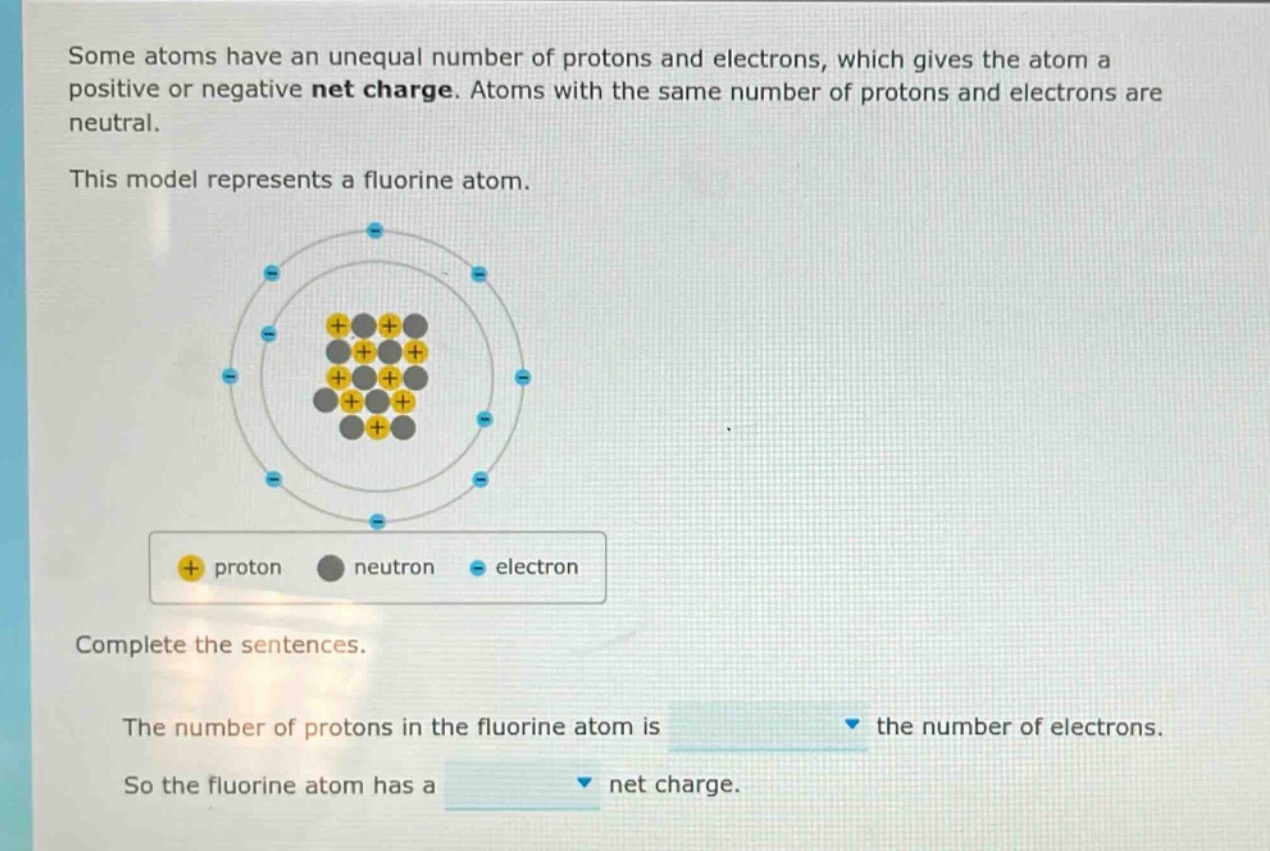
some atoms have an unequal number of protons and electrons, which gives the atom a positive or negative net charge. atoms with the same number of protons and electrons are neutral. this model represents a fluorine atom. complete the sentences. the number of protons in the fluorine atom is the number of electrons. so the fluorine atom has a net charge.
Answer
Explanation:
Step1: Count particles
Count the number of protons (yellow - +) and electrons (blue - -) in the fluorine atom model. There are 9 protons and 9 electrons.
Step2: Determine charge
Since the number of protons (positive - charged particles) equals the number of electrons (negative - charged particles), the net charge is calculated as (9+( - 9)=0).
Answer:
The number of protons in the fluorine atom is equal to the number of electrons. So the fluorine atom has a neutral net charge.