some atoms have an unequal number of protons and electrons, which gives the atom a positive or negative net…
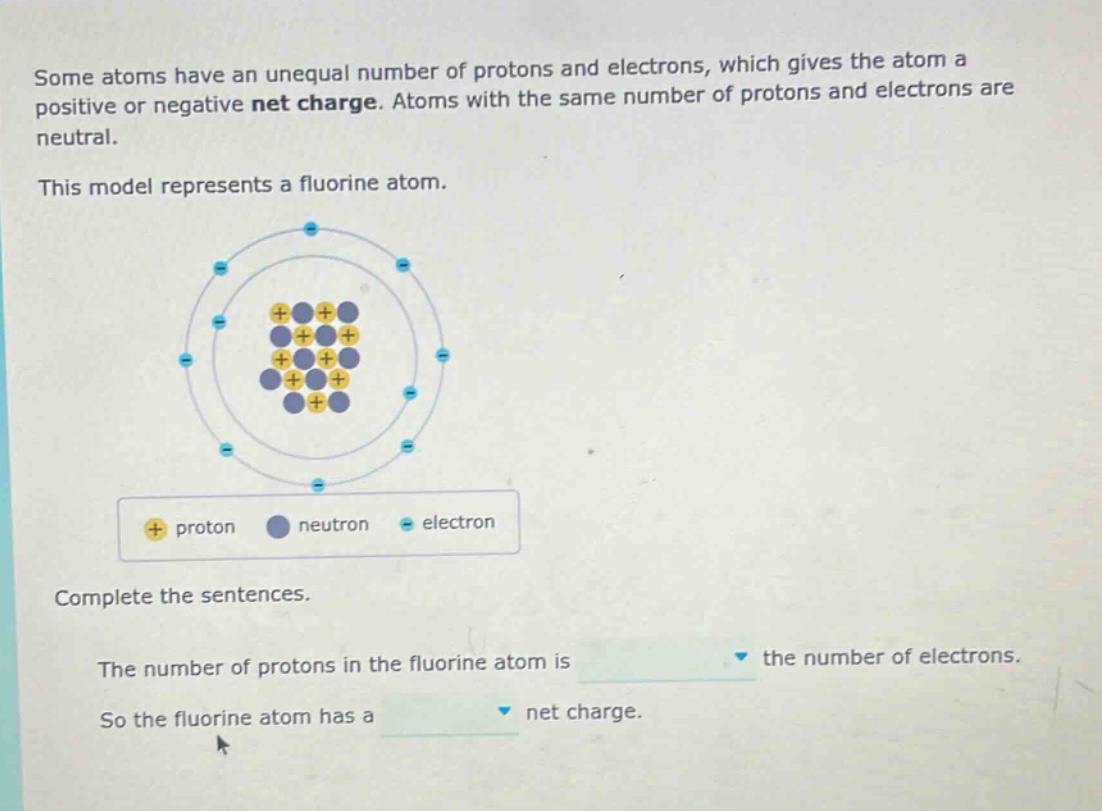
some atoms have an unequal number of protons and electrons, which gives the atom a positive or negative net charge. atoms with the same number of protons and electrons are neutral. this model represents a fluorine atom. complete the sentences. the number of protons in the fluorine atom is the number of electrons. so the fluorine atom has a net charge.
Answer
Explanation:
Step1: Count protons and electrons
Count the number of protons (yellow + symbols) and electrons (blue - symbols) in the fluorine - atom model. There are 9 protons and 9 electrons.
Step2: Determine net charge
Since the number of protons (9) equals the number of electrons (9), using the rule that when the number of protons and electrons is the same, the atom is neutral.
Answer:
The number of protons in the fluorine atom is equal to the number of electrons. So the fluorine atom has a neutral net charge.