balance the chemical equation below using the smallest possible whole number stoichiometric coefficients…
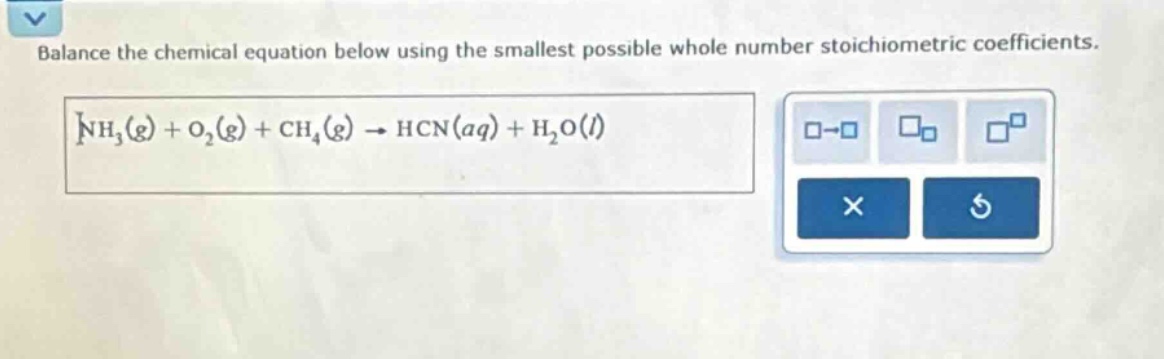
balance the chemical equation below using the smallest possible whole number stoichiometric coefficients. nh₃(g) + o₂(g) + ch₄(g) → hcn(aq) + h₂o(l)
Answer
Explanation:
Step1: Balance nitrogen atoms
There is 1 nitrogen atom on the left - hand side in $NH_3$ and 1 in $HCN$ on the right - hand side, so nitrogen is already balanced for now.
Step2: Balance carbon atoms
There is 1 carbon atom in $CH_4$ on the left - hand side and 1 in $HCN$ on the right - hand side, so carbon is already balanced for now.
Step3: Balance hydrogen atoms
On the left - hand side, the number of hydrogen atoms from $NH_3$ and $CH_4$ is $3 + 4=7$. On the right - hand side, hydrogen is in $HCN$ and $H_2O$. Let's start by adjusting the coefficients. Let's assume the coefficient of $NH_3$ is $a = 2$, the coefficient of $O_2$ is $b$, the coefficient of $CH_4$ is $c = 2$, the coefficient of $HCN$ is $d = 2$ and the coefficient of $H_2O$ is $e$. The number of hydrogen atoms from $2NH_3$ and $2CH_4$ is $2\times3+2\times4 = 14$. The number of hydrogen atoms in $2HCN$ and $eH_2O$ is $2 + 2e$. So $2+2e=14$, which gives $e = 6$.
Step4: Balance oxygen atoms
The number of oxygen atoms in $bO_2$ should equal the number of oxygen atoms in $6H_2O$. Since there are 6 oxygen atoms in $6H_2O$, and oxygen comes from $O_2$, then $2b=6$, so $b = 3$.
The balanced chemical equation is $2NH_3(g)+3O_2(g)+2CH_4(g)\rightarrow2HCN(aq)+6H_2O(l)$
Answer:
$2NH_3(g)+3O_2(g)+2CH_4(g)\rightarrow2HCN(aq)+6H_2O(l)$