balance the chemical equation below using the smallest possible whole number stoichiometric coefficients…
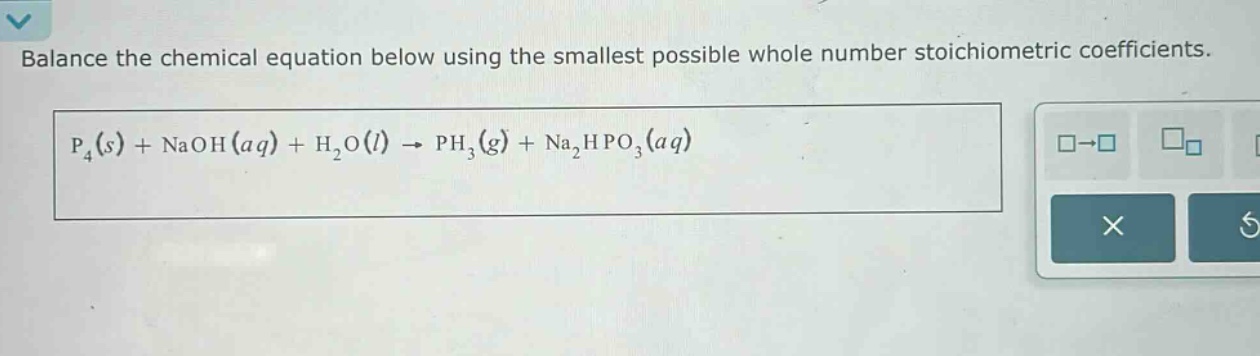
balance the chemical equation below using the smallest possible whole number stoichiometric coefficients. p₄(s) + naoh(aq) + h₂o(l) → ph₃(g) + na₂hpo₃(aq)
Answer
Explanation:
Step1: Balance phosphorus atoms
Let the coefficient of $P_4$ be $1$. In $PH_3$ and $Na_2HPO_3$, the total number of phosphorus - containing products should account for 4 phosphorus atoms from $P_4$. Let the coefficient of $PH_3$ be $x$ and the coefficient of $Na_2HPO_3$ be $y$, then $x + y=4$.
Step2: Balance sodium atoms
The sodium in $NaOH$ goes to $Na_2HPO_3$. If the coefficient of $Na_2HPO_3$ is $y$, the coefficient of $NaOH$ is $2y$.
Step3: Balance hydrogen and oxygen atoms
The hydrogen atoms in $NaOH$ and $H_2O$ go to $PH_3$ and $Na_2HPO_3$, and the oxygen atoms in $NaOH$ and $H_2O$ go to $Na_2HPO_3$. By trial - and - error, when $x = 3$ and $y = 1$: The balanced equation is $P_4(s)+3NaOH(aq)+3H_2O(l)\rightarrow3PH_3(g)+Na_2HPO_3(aq)$.
Answer:
$P_4(s)+3NaOH(aq)+3H_2O(l)\rightarrow3PH_3(g)+Na_2HPO_3(aq)$