balance the reaction of potassium hydroxide and iron(ii) chloride to give iron(ii) hydroxide and potassium…
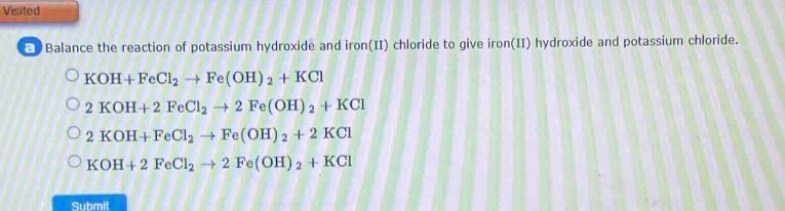
balance the reaction of potassium hydroxide and iron(ii) chloride to give iron(ii) hydroxide and potassium chloride. koh+fecl₂ → fe(oh)₂ + kcl 2 koh+2 fecl₂ → 2 fe(oh)₂ + kcl 2 koh+fecl₂ → fe(oh)₂ + 2 kcl koh+2 fecl₂ → 2 fe(oh)₂ + kcl
Answer
Explanation:
Step1: Check element - by - element balance
For the reaction between potassium hydroxide ($KOH$) and iron(II) chloride ($FeCl_2$) to form iron(II) hydroxide ($Fe(OH)_2$) and potassium chloride ($KCl$), we need to ensure that the number of each type of atom is the same on both sides of the chemical equation. The unbalanced equation is $KOH + FeCl_2\rightarrow Fe(OH)_2+KCl$. On the left - hand side: 1 $K$, 1 $O$, 1 $H$, 1 $Fe$, 2 $Cl$. On the right - hand side: 1 $K$, 2 $O$, 2 $H$, 1 $Fe$, 1 $Cl$.
Step2: Balance the chlorine atoms
To balance the chlorine atoms, since there are 2 chlorine atoms in $FeCl_2$, we need 2 moles of $KCl$. So the equation becomes $KOH + FeCl_2\rightarrow Fe(OH)_2 + 2KCl$. Now, on the right - hand side, we have 2 $K$ atoms.
Step3: Balance the potassium and hydroxide groups
To balance the potassium and hydroxide groups, we need 2 moles of $KOH$. The balanced equation is $2KOH+FeCl_2\rightarrow Fe(OH)_2 + 2KCl$.
Answer:
$2KOH + FeCl_2\rightarrow Fe(OH)_2+2KCl$ (the third option)