a base is added to water. what happens when the position of equilibrium lies to the left?\nthe base is…
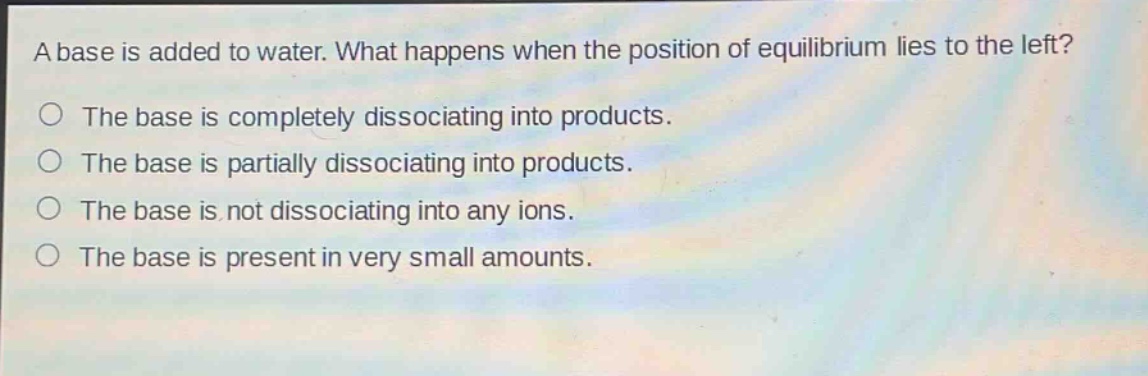
a base is added to water. what happens when the position of equilibrium lies to the left?\nthe base is completely dissociating into products.\nthe base is partially dissociating into products.\nthe base is not dissociating into any ions.\nthe base is present in very small amounts.
Answer
Brief Explanations:
In a chemical - equilibrium context, when the position of equilibrium lies to the left for a base - water reaction, it means the reverse reaction is favored. This indicates that the base is not fully dissociating into its ions (products). A complete dissociation would have the equilibrium lie to the right. If the base is not dissociating into any ions, the reaction would not be in an equilibrium state related to dissociation. The amount of base present is not directly related to the position of equilibrium in terms of left - right shift for dissociation. A partial dissociation is indicated when the equilibrium lies to the left as there is a significant amount of the undissociated base remaining.
Answer:
The base is partially dissociating into products.