if the base - dissociation constant, $k_b$, for a substance is $4.3\times10^{-10}$, what does this tell you…
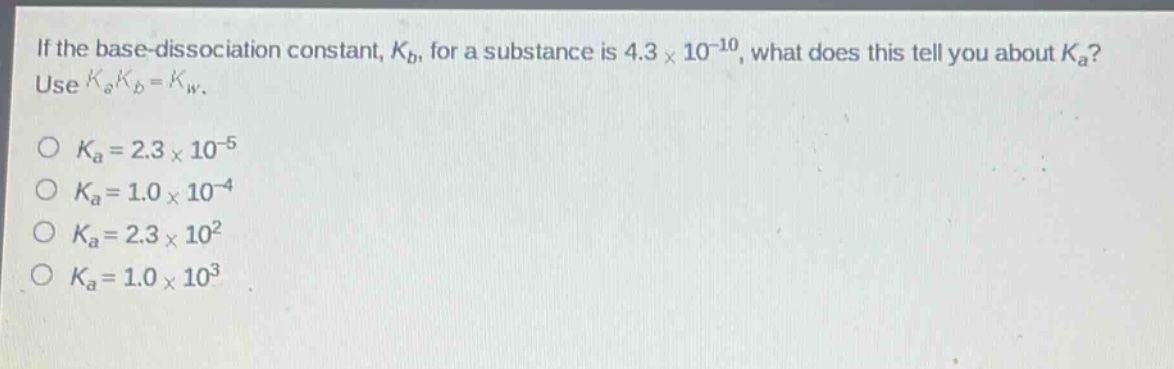
if the base - dissociation constant, $k_b$, for a substance is $4.3\times10^{-10}$, what does this tell you about $k_a$? use $k_ak_b = k_w$.\n$k_a = 2.3\times10^{-5}$\n$k_a = 1.0\times10^{-4}$\n$k_a = 2.3\times10^{2}$\n$k_a = 1.0\times10^{3}$
Answer
Explanation:
Step1: Recall the relationship formula
We know that $K_aK_b = K_w$, and at $25^{\circ}C$, $K_w=1.0\times 10^{- 14}$.
Step2: Solve for $K_a$
Given $K_b = 4.3\times10^{-10}$, we can find $K_a$ by $K_a=\frac{K_w}{K_b}$. Substitute the values: $K_a=\frac{1.0\times 10^{-14}}{4.3\times 10^{-10}}$. Using the rule of exponents $\frac{a^m}{a^n}=a^{m - n}$, we have $K_a=\frac{1.0}{4.3}\times10^{-14+10}\approx0.23\times10^{- 4}=2.3\times10^{-5}$.
Answer:
$K_a = 2.3\times 10^{-5}$