4 base your answer to the following question on the graph below and on your knowledge of earth science. the…
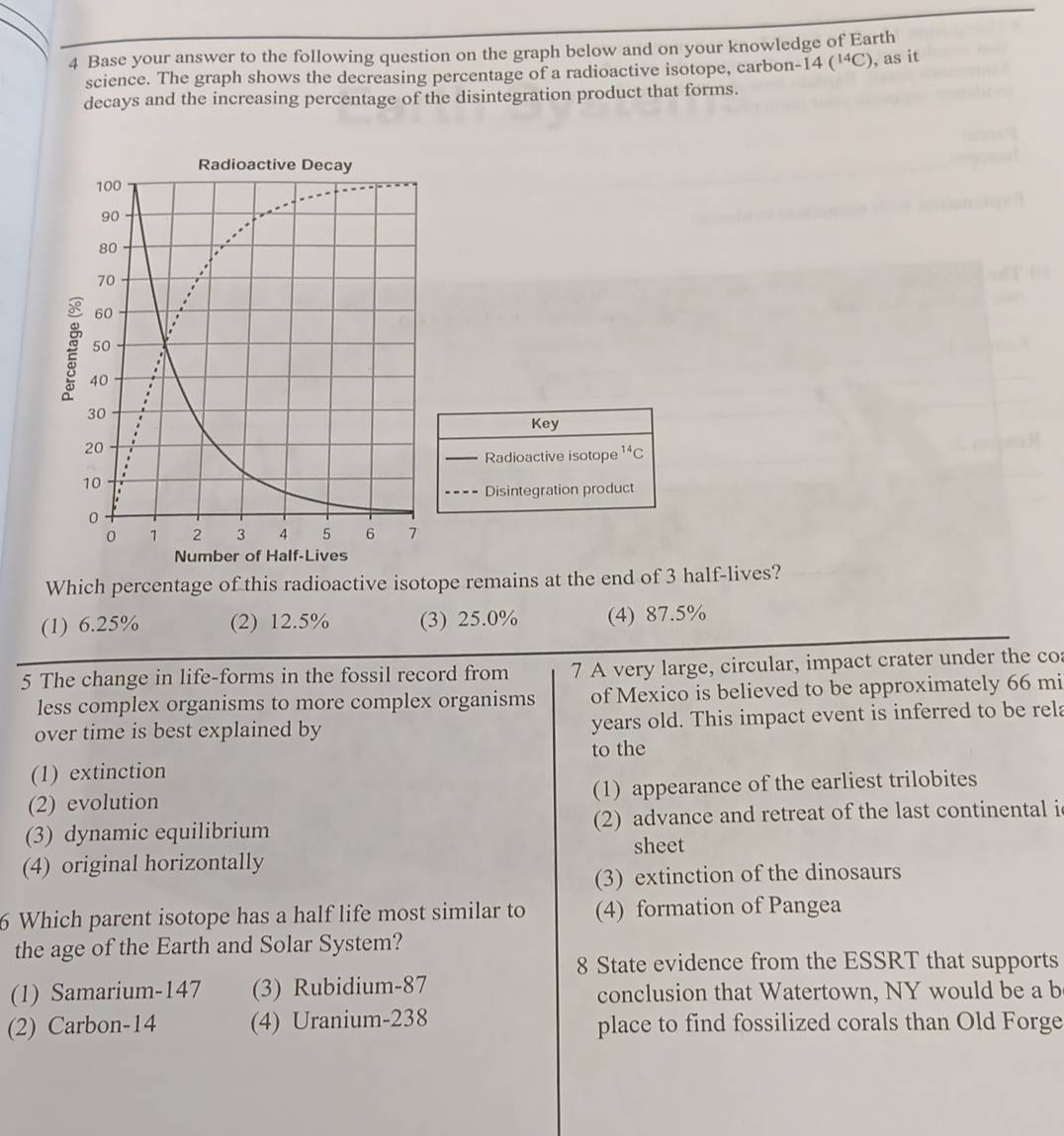
4 base your answer to the following question on the graph below and on your knowledge of earth science. the graph shows the decreasing percentage of a radioactive isotope, carbon - 14 (¹⁴c), as it decays and the increasing percentage of the disintegration product that forms. radioactive decay key — radioactive isotope ¹⁴c - - - - disintegration product which percentage of this radioactive isotope remains at the end of 3 half - lives? (1) 6.25% (2) 12.5% (3) 25.0% (4) 87.5% 5 the change in life - forms in the fossil record from less complex organisms to more complex organisms over time is best explained by (1) extinction (2) evolution (3) dynamic equilibrium (4) original horizontally 6 which parent isotope has a half life most similar to the age of the earth and solar system? (1) samarium - 147 (2) carbon - 14 (3) rubidium - 87 (4) uranium - 238 7 a very large, circular, impact crater under the coast of mexico is believed to be approximately 66 million years old. this impact event is inferred to be related to the (1) appearance of the earliest trilobites (2) advance and retreat of the last continental ice sheet (3) extinction of the dinosaurs (4) formation of pangea 8 state evidence from the essrt that supports the conclusion that watertown, ny would be a better place to find fossilized corals than old forge.
Answer
Question 4
Explanation:
Step1: Recall half - life concept
The amount of a radioactive isotope remaining after (n) half - lives is given by the formula (N = N_0\times(\frac{1}{2})^n), where (N_0) is the initial amount and (n) is the number of half - lives. Here, we want to find the percentage remaining, and we can assume (N_0 = 100%).
Step2: Substitute (n = 3) into the formula
When (n = 3), (N=100%\times(\frac{1}{2})^3=100%\times\frac{1}{8} = 12.5%)
Answer:
(2) 12.5%
Question 5
Brief Explanations:
The change from less complex to more complex life - forms in the fossil record over time is a key concept of evolution. Evolution is the process by which species change over generations through mechanisms like natural selection.
Answer:
(2) evolution
Question 6
Brief Explanations:
The age of the Earth and Solar System is about 4.6 billion years. Uranium - 238 has a half - life of about 4.47 billion years, which is closest to the age of the Earth and Solar System among the given isotopes.
Answer:
(4) Uranium - 238
Question 7
Brief Explanations:
The large circular impact crater in Mexico is associated with the Chicxulub impact, which is widely believed to be related to the extinction of the dinosaurs about 66 million years ago.
Answer:
(3) extinction of the dinosaurs
Question 8
Sorry, the text provided is not valid. Please provide more details or clarify your question so I can assist you better. (Since no information about ESSRT or relevant details for this part is given)