base your answer to the following question on the information below. iron has been used for thousands of…
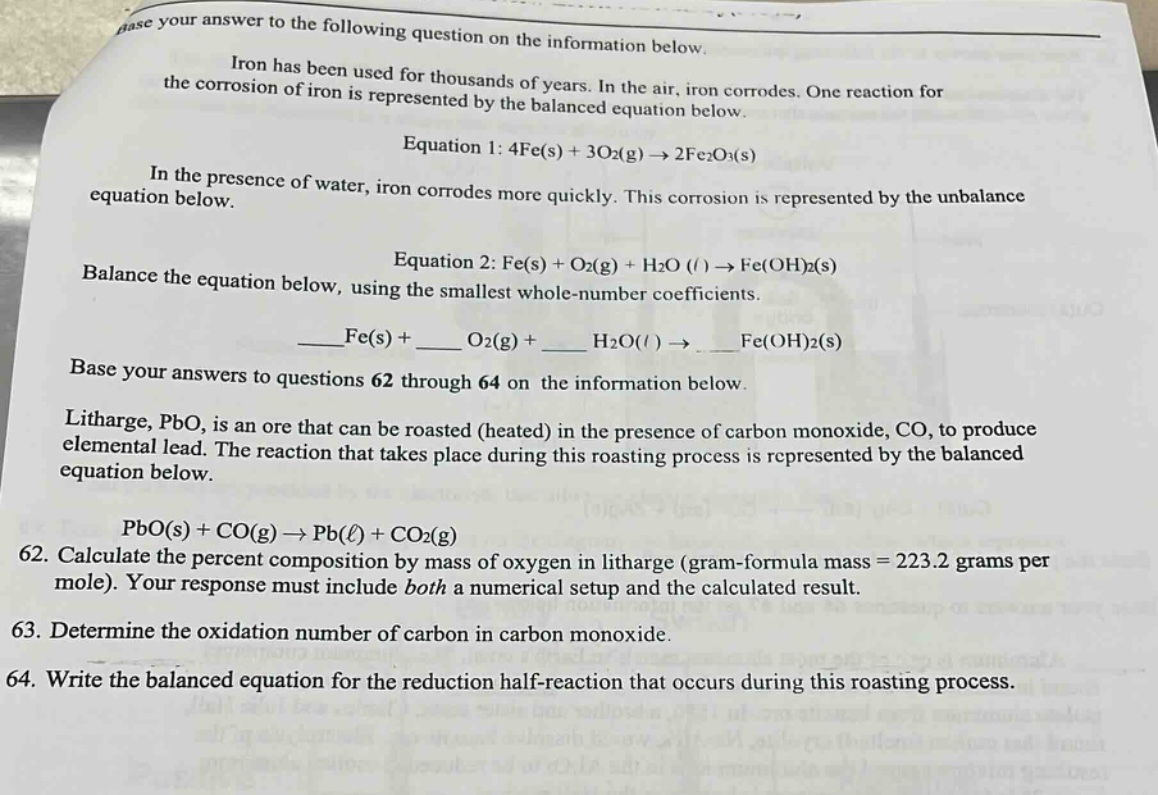
base your answer to the following question on the information below. iron has been used for thousands of years. in the air, iron corrodes. one reaction for the corrosion of iron is represented by the balanced equation below. equation 1: 4fe(s) + 3o2(g) → 2fe2o3(s) in the presence of water, iron corrodes more quickly. this corrosion is represented by the unbalance equation below. equation 2: fe(s) + o2(g) + h2o (l) → fe(oh)2(s) balance the equation below, using the smallest whole - number coefficients. ____fe(s) + ____ o2(g) + ____ h2o(l) → ____ fe(oh)2(s) base your answers to questions 62 through 64 on the information below. litharge, pbo, is an ore that can be roasted (heated) in the presence of carbon monoxide, co, to produce elemental lead. the reaction that takes place during this roasting process is represented by the balanced equation below. pbo(s) + co(g) → pb(ℓ) + co2(g) 62. calculate the percent composition by mass of oxygen in litharge (gram - formula mass = 223.2 grams per mole). your response must include both a numerical setup and the calculated result. 63. determine the oxidation number of carbon in carbon monoxide. 64. write the balanced equation for the reduction half - reaction that occurs during this roasting process.
Answer
Explanation:
Step1: Balance the iron - corrosion equation
We need to balance the equation $\text{Fe(s)}+\text{O}_2\text{(g)}+\text{H}_2\text{O(l)}\to\text{Fe(OH)}_2\text{(s)}$. We start by looking at the number of atoms on each side. For iron, oxygen and hydrogen. Let's assume the coefficients of $\text{Fe}$, $\text{O}_2$, $\text{H}_2\text{O}$ and $\text{Fe(OH)}_2$ are $a$, $b$, $c$ and $d$ respectively. So the equation is $a\text{Fe(s)}+b\text{O}_2\text{(g)}+c\text{H}_2\text{O(l)}\to d\text{Fe(OH)}_2\text{(s)}$. For iron atoms: $a = d$. For oxygen atoms: $2b + c=2d$. For hydrogen atoms: $2c = 2d$. By trial - and - error or systematic balancing, we find that $2\text{Fe(s)}+\text{O}_2\text{(g)}+2\text{H}_2\text{O(l)}\to2\text{Fe(OH)}_2\text{(s)}$.
Step2: Calculate percent composition of oxygen in litharge
The formula for percent composition by mass of an element $X$ in a compound $ABX_n$ is $\text{Percent composition of }X=\frac{n\times\text{atomic mass of }X}{\text{molar mass of }ABX_n}\times100%$. The atomic mass of oxygen ($O$) is approximately $16.0$ g/mol, and the gram - formula mass of litharge ($\text{PbO}$) is $223.2$ g/mol. The numerical setup is $\frac{16.0}{223.2}\times100%$. Calculating, we get $\frac{16.0}{223.2}\times100%\approx7.17%$.
Step3: Determine oxidation number of carbon in CO
Let the oxidation number of carbon in $\text{CO}$ be $x$. Oxygen has an oxidation number of $- 2$ in most compounds. In a neutral compound, the sum of oxidation numbers is zero. So for $\text{CO}$, we have $x+( - 2)=0$. Solving for $x$, we get $x = + 2$.
Step4: Write the reduction half - reaction
In the reaction $\text{PbO(s)}+\text{CO(g)}\to\text{Pb(l)}+\text{CO}_2\text{(g)}$, the reduction half - reaction involves the gain of electrons. $\text{PbO}$ is reduced to $\text{Pb}$. The balanced reduction half - reaction is $\text{Pb}^{2 + }+2e^-\to\text{Pb}$.
Answer:
For the iron - corrosion equation: $2\text{Fe(s)}+\text{O}_2\text{(g)}+2\text{H}_2\text{O(l)}\to2\text{Fe(OH)}_2\text{(s)}$ For percent composition of oxygen in litharge: Numerical setup: $\frac{16.0}{223.2}\times100%$, Result: $\approx7.17%$ For oxidation number of carbon in $\text{CO}$: $+2$ For the reduction half - reaction: $\text{Pb}^{2 + }+2e^-\to\text{Pb}$