base your answers to questions 20 and 21 on the chart below. global summary of the hiv epidemic in women and…
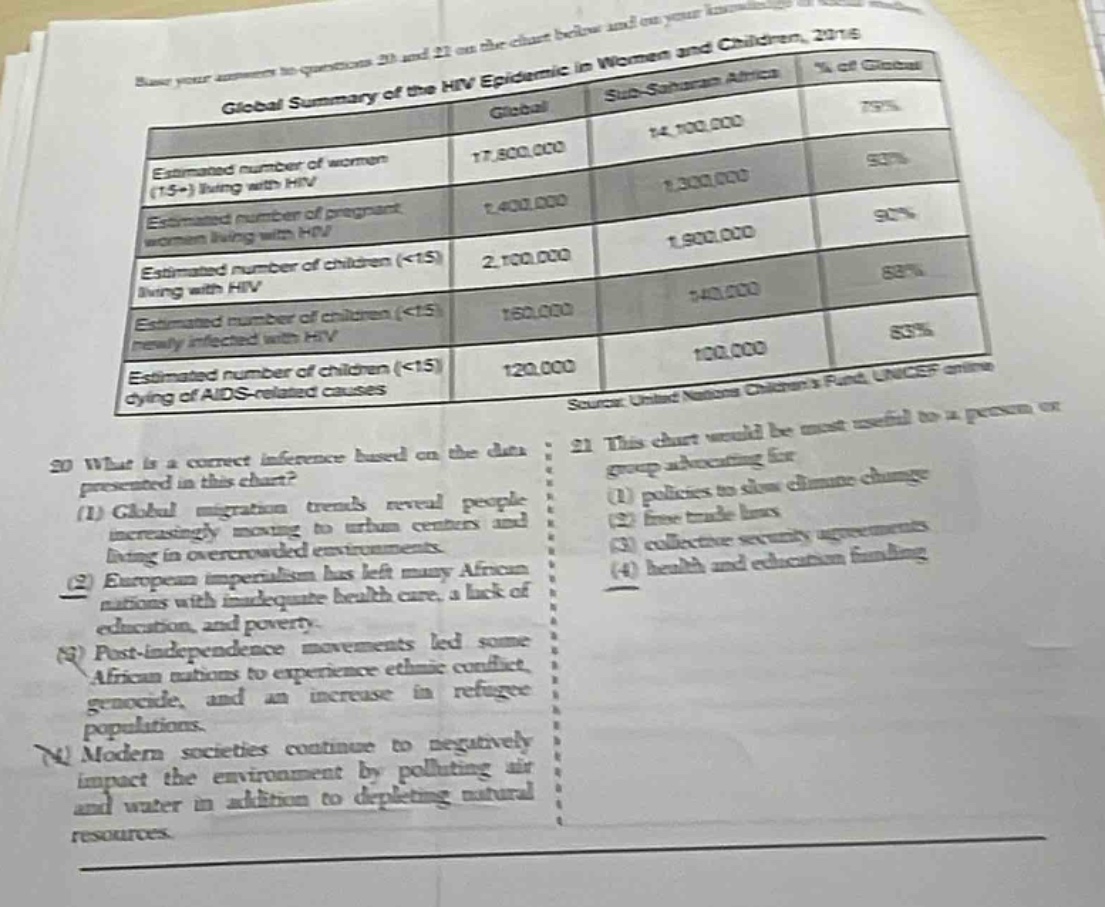
base your answers to questions 20 and 21 on the chart below. global summary of the hiv epidemic in women and children, 2016\n| | global | sub - saharan africa | % of global |\n|--|--|--|--|\n| estimated number of women (15+) living with hiv | 17,800,000 | 14,700,000 | 73% |\n| estimated number of pregnant women living with hiv | 1,400,000 | 1,300,000 | 93% |\n| estimated number of children (<15) living with hiv | 2,100,000 | 1,900,000 | 88% |\n| estimated number of children (<15) newly infected with hiv | 160,000 | 140,000 | 88% |\n| estimated number of children (<15) dying of aids - related causes | 120,000 | 100,000 | 83% |\nsource: united nations childrens fund, unicef online\n20 what is a correct inference based on the data presented in this chart?\n(1) global migration trends reveal people increasingly moving to urban centers and living in overcrowded environments.\n(2) european imperialism has left many african nations with inadequate health care, a lack of education, and poverty.\n(3) post - independence movements led some african nations to experience ethnic conflict, genocide, and an increase in refugee populations.\n(4) modern societies continue to negatively impact the environment by polluting air and water in addition to depleting natural resources.\n21 this chart would be most useful to a person or group advocating for\n(1) policies to slow climate change\n(2) free trade laws\n(3) collective security agreements\n(4) health and education funding
Answer
Brief Explanations:
The chart provides data on the HIV - epidemic in women and children globally and in Sub - Saharan Africa. This data would be most relevant to those advocating for health and education funding as it highlights the significant number of women and children affected by HIV. For question 20, none of the options are correct inferences based on the data in the chart as the chart only pertains to HIV statistics and not the topics mentioned in the options. For question 21, the chart would be most useful to a person or group advocating for health and education funding.
Answer:
- None of the above
- (4) health and education funding