based on the activity series provided, which reactants will form products? f > cl > br > i\ncui2 + br2…
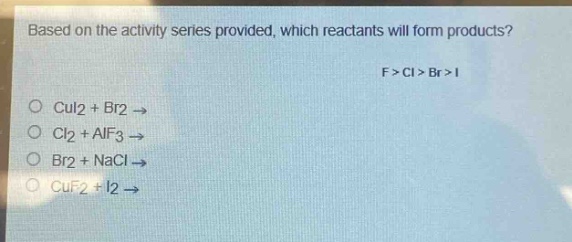
based on the activity series provided, which reactants will form products? f > cl > br > i\ncui2 + br2 →\ncl2 + alf3 →\nbr2 + nacl →\ncuf2 + i2 →
Answer
Answer:
CuI2 + Br2 →
Explanation:
Step1: Recall activity - series rule
A more reactive halogen can displace a less reactive halogen from its salt.
Step2: Analyze CuI2 + Br2
Bromine (Br) is more reactive than iodine (I) according to F > Cl > Br > I. So Br2 can displace I - from CuI2.
Step3: Analyze Cl2 + AlF3
Fluorine (F) is more reactive than chlorine (Cl), so Cl2 cannot displace F - from AlF3.
Step4: Analyze Br2 + NaCl
Chlorine (Cl) is more reactive than bromine (Br), so Br2 cannot displace Cl - from NaCl.
Step5: Analyze CuF2 + I2
Fluorine (F) is more reactive than iodine (I), so I2 cannot displace F - from CuF2.