based on the definition of logarithms, what is the difference in hydrogen ion concentration between a…
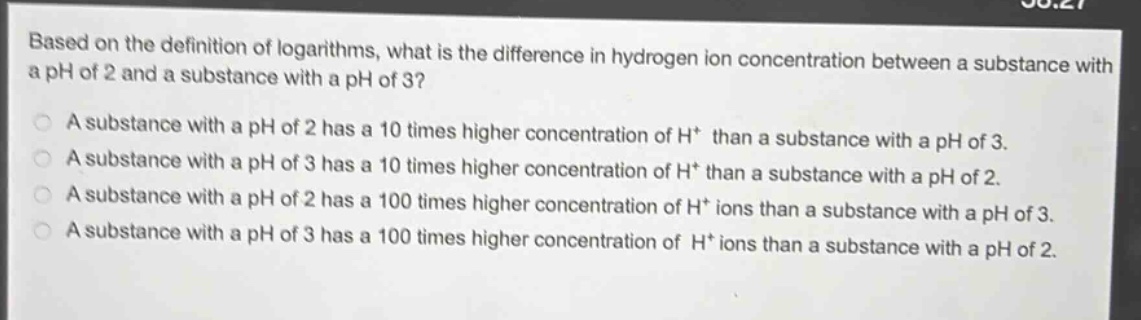
based on the definition of logarithms, what is the difference in hydrogen ion concentration between a substance with a ph of 2 and a substance with a ph of 3?\na substance with a ph of 2 has a 10 times higher concentration of h+ than a substance with a ph of 3.\na substance with a ph of 3 has a 10 times higher concentration of h+ than a substance with a ph of 2.\na substance with a ph of 2 has a 100 times higher concentration of h+ ions than a substance with a ph of 3.\na substance with a ph of 3 has a 100 times higher concentration of h+ ions than a substance with a ph of 2.
Answer
Explanation:
Step1: Recall pH formula
The formula for pH is $pH = -\log[H^+]$, where $[H^+]$ is the hydrogen - ion concentration. So, $[H^+]=10^{-pH}$.
Step2: Calculate $[H^+]$ for pH = 2
When $pH = 2$, $[H^+]_1=10^{-2}$.
Step3: Calculate $[H^+]$ for pH = 3
When $pH = 3$, $[H^+]_2=10^{-3}$.
Step4: Find the ratio of the two concentrations
$\frac{[H^+]_1}{[H^+]_2}=\frac{10^{-2}}{10^{-3}}$. Using the rule of exponents $\frac{a^m}{a^n}=a^{m - n}$, we have $\frac{10^{-2}}{10^{-3}}=10^{-2-(-3)} = 10^1 = 10$. So, a substance with a pH of 2 has a 10 times higher concentration of $H^+$ than a substance with a pH of 3.
Answer:
A. A substance with a pH of 2 has a 10 times higher concentration of $H^+$ than a substance with a pH of 3.