based on their formulas and specific heat capacity (4.184 j/g°c for water and 2.43 j/g°c for ethanol), what…
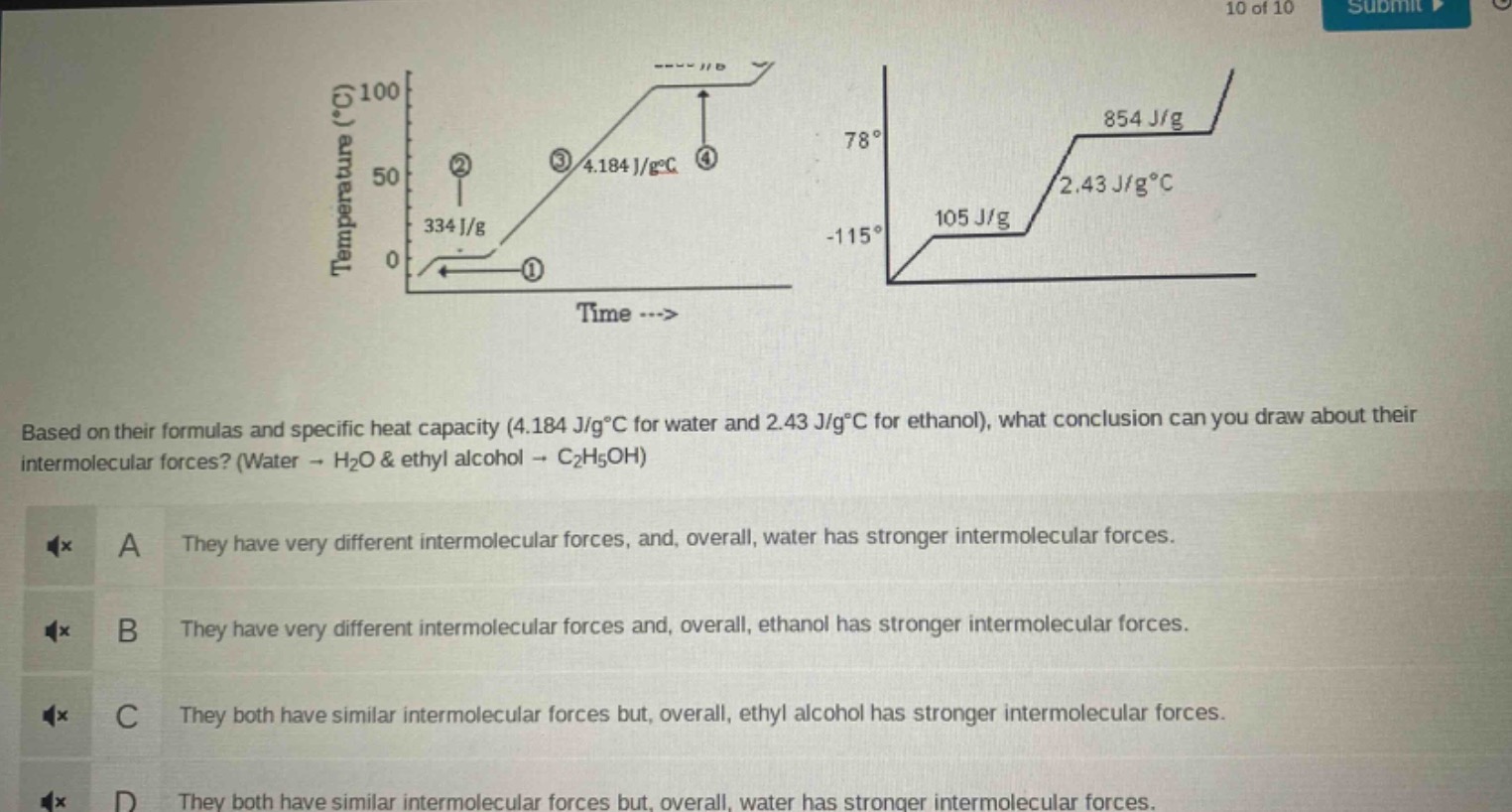
based on their formulas and specific heat capacity (4.184 j/g°c for water and 2.43 j/g°c for ethanol), what conclusion can you draw about their intermolecular forces? (water → h₂o & ethyl alcohol → c₂h₅oh)\na they have very different intermolecular forces, and, overall, water has stronger intermolecular forces.\nb they have very different intermolecular forces and, overall, ethanol has stronger intermolecular forces.\nc they both have similar intermolecular forces but, overall, ethyl alcohol has stronger intermolecular forces.\nd they both have similar intermolecular forces but, overall, water has stronger intermolecular forces.
Answer
Brief Explanations:
The specific - heat capacity is related to intermolecular forces. A higher specific - heat capacity indicates that more energy is required to change the temperature of a substance, which means stronger intermolecular forces holding the molecules together. Water has a specific - heat capacity of 4.184 J/g°C and ethanol has a specific - heat capacity of 2.43 J/g°C. Water has a higher specific - heat capacity, so it has stronger intermolecular forces. Also, water (H₂O) and ethanol (C₂H₅OH) have different molecular structures and thus different intermolecular forces.
Answer:
A. They have very different intermolecular forces, and, overall, water has stronger intermolecular forces.