the boiling point of a solution is always higher than the pure solvent. a true b false
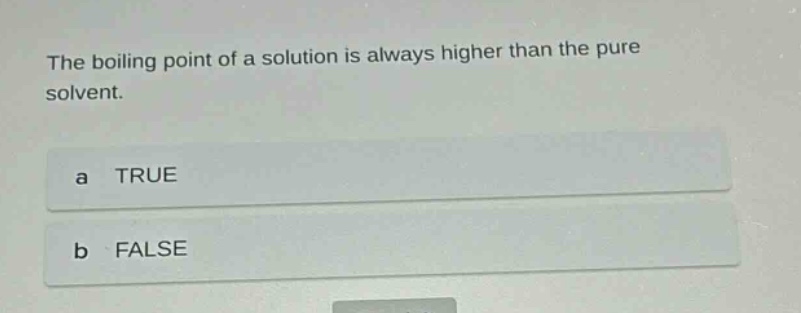
the boiling point of a solution is always higher than the pure solvent. a true b false
Answer
Brief Explanations:
When a non - volatile solute is added to a solvent, the vapor pressure of the solvent decreases. According to the boiling point elevation formula $\Delta T_b = K_b\times m$, where $\Delta T_b$ is the elevation in boiling point, $K_b$ is the ebullioscopic constant of the solvent, and $m$ is the molality of the solution. Since $\Delta T_b>0$ for a non - volatile solute solution (as $K_b>0$ and $m > 0$ when solute is present), the boiling point of the solution ($T_b(solution)=T_b(solvent)+\Delta T_b$) is higher than that of the pure solvent. However, if the solute is volatile, it may have a lower boiling point than the solvent. For example, if we have a solution of a volatile liquid (lower boiling point than the solvent) in a solvent, the boiling point of the solution may be lower than that of the pure solvent.
Answer:
b. FALSE