boiling points of some diatomic gases\nelement boiling point °c\nh₂ -252.7\nf₂ -187\ncl₂ -34.6\nbr₂…
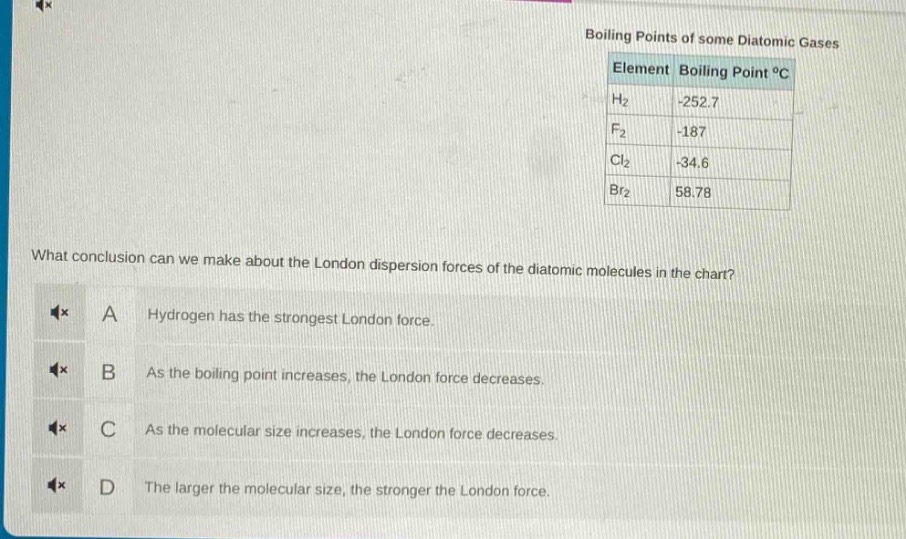
boiling points of some diatomic gases\nelement boiling point °c\nh₂ -252.7\nf₂ -187\ncl₂ -34.6\nbr₂ 58.78\nwhat conclusion can we make about the london dispersion forces of the diatomic molecules in the chart?\na hydrogen has the strongest london force.\nb as the boiling point increases, the london force decreases.\nc as the molecular size increases, the london force decreases.\nd the larger the molecular size, the stronger the london force.
Answer
Brief Explanations:
London dispersion forces are weak intermolecular forces. Larger molecules have more electrons, leading to stronger temporary dipoles and thus stronger London - dispersion forces. Higher boiling points indicate stronger intermolecular forces. As we move from $H_2$ to $Br_2$, molecular size increases and so does the boiling point, showing stronger London forces.
Answer:
D. The larger the molecular size, the stronger the London force.