which of the bonds (labelled a - d) are likely to be highly polar? (check all that apply)\n□ c\n□ d\n□ b\n□ a
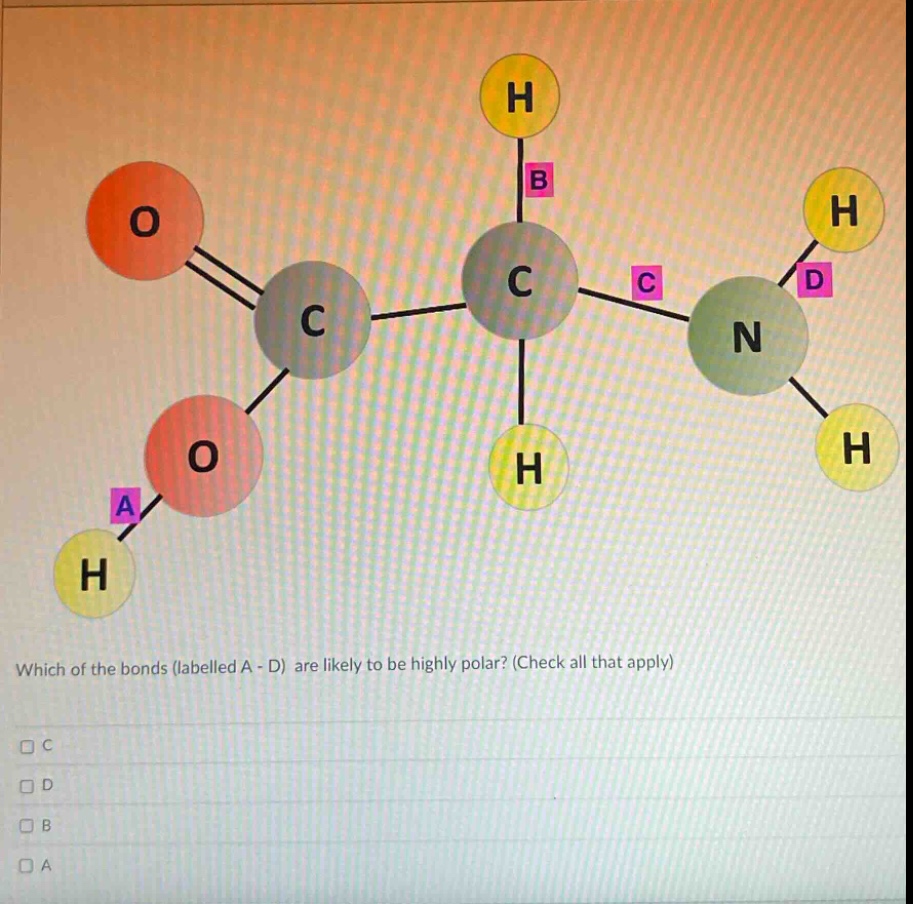
which of the bonds (labelled a - d) are likely to be highly polar? (check all that apply)\n□ c\n□ d\n□ b\n□ a
Answer
Explanation:
Step1: Recall polarity concept
Polarity is due to electronegativity difference.
Step2: Analyze electronegativities
Oxygen is highly electronegative. Hydrogen has lower electronegativity. Nitrogen is also electronegative but less than oxygen.
Step3: Evaluate each bond
- Bond A (O - H): Large electronegativity difference (O is 3.44, H is 2.20), highly polar.
- Bond B (C - H): Small electronegativity difference (C is 2.55, H is 2.20), less polar.
- Bond C (C - C): Same atoms, electronegativity difference is 0, non - polar.
- Bond D (N - H): Electronegativity difference (N is 3.04, H is 2.20), polar but less than O - H.
Answer:
A. A