calcium carbonate ($caco_3$) is a white solid with no odor. when $caco_3$ is heated, the resulting…
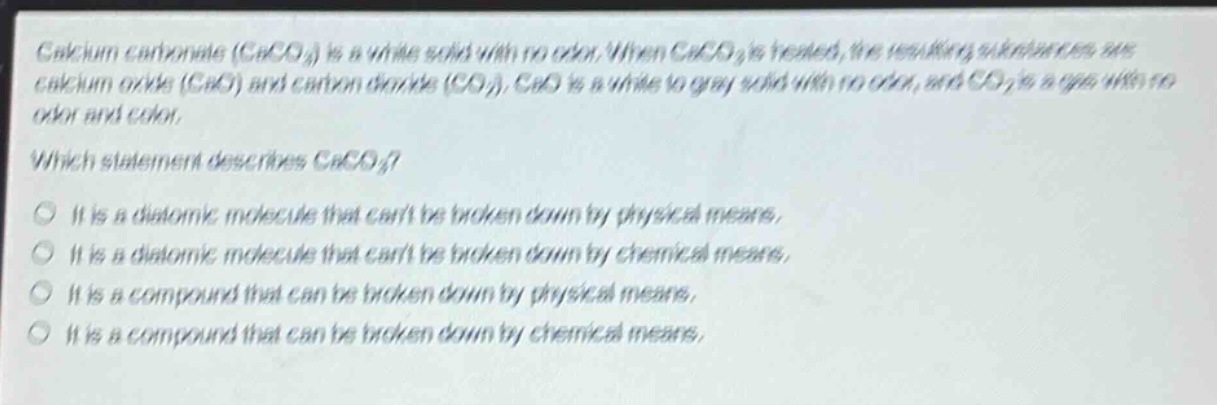
calcium carbonate ($caco_3$) is a white solid with no odor. when $caco_3$ is heated, the resulting substances are calcium oxide ($cao$) and carbon dioxide ($co_2$). $cao$ is a white to gray solid with no odor, and $co_2$ is a gas with no odor and color.\nwhich statement describes $caco_3$?\no it is a diatomic molecule that cant be broken down by physical means.\no it is a diatomic molecule that cant be broken down by chemical means.\no it is a compound that can be broken down by physical means.\no it is a compound that can be broken down by chemical means.
Answer
Brief Explanations:
Calcium carbonate ($CaCO_3$) is made of calcium, carbon and oxygen atoms, so it's a compound. Heating it (a chemical process) breaks it into calcium oxide and carbon - dioxide. Physical means can't break it down.
Answer:
It is a compound that can be broken down by chemical means.