calorimetric studies show that the reaction is exothermic. 2no2(g) ⇌ n2o4(g) + 14.1 kcal. based on this…
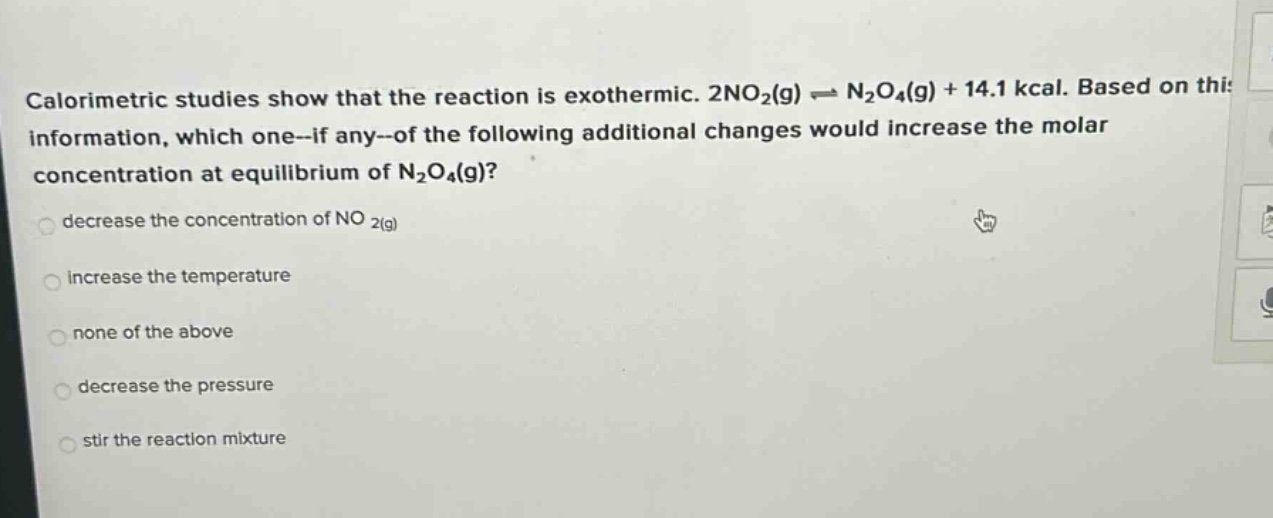
calorimetric studies show that the reaction is exothermic. 2no2(g) ⇌ n2o4(g) + 14.1 kcal. based on this information, which one--if any--of the following additional changes would increase the molar concentration at equilibrium of n2o4(g)? decrease the concentration of no 2(g) increase the temperature none of the above decrease the pressure stir the reaction mixture
Answer
Explanation:
Step1: Recall Le - Chatelier's principle
Le - Chatelier's principle states that a system at equilibrium will respond to a change in conditions to counteract that change.
Step2: Analyze effect of decreasing $\text{NO}_2$ concentration
Decreasing the concentration of $\text{NO}_2$ will shift the equilibrium in the direction that produces more $\text{NO}_2$, i.e., the reverse direction. So, the concentration of $\text{N}_2\text{O}_4$ will decrease.
Step3: Analyze effect of increasing temperature
Since the reaction $2\text{NO}_2(\text{g})\rightleftharpoons\text{N}_2\text{O}_4(\text{g})+ 14.1\text{ kcal}$ is exothermic, increasing the temperature will shift the equilibrium in the endothermic (reverse) direction. So, the concentration of $\text{N}_2\text{O}_4$ will decrease.
Step4: Analyze effect of decreasing pressure
The forward reaction has a decrease in the number of moles of gas (2 moles of $\text{NO}_2$ to 1 mole of $\text{N}_2\text{O}_4$). Decreasing the pressure will shift the equilibrium in the direction of more moles of gas, i.e., the reverse direction. So, the concentration of $\text{N}_2\text{O}_4$ will decrease.
Step5: Analyze effect of stirring
Stirring the reaction mixture only affects the rate of reaching equilibrium, not the position of equilibrium. So, it has no effect on the molar - concentration of $\text{N}_2\text{O}_4$ at equilibrium.
Answer:
none of the above