carlos is making phosphorus trichloride using the equation below. 2p + 3cl₂ → _pcl₃ what coefficient of pcl₃…
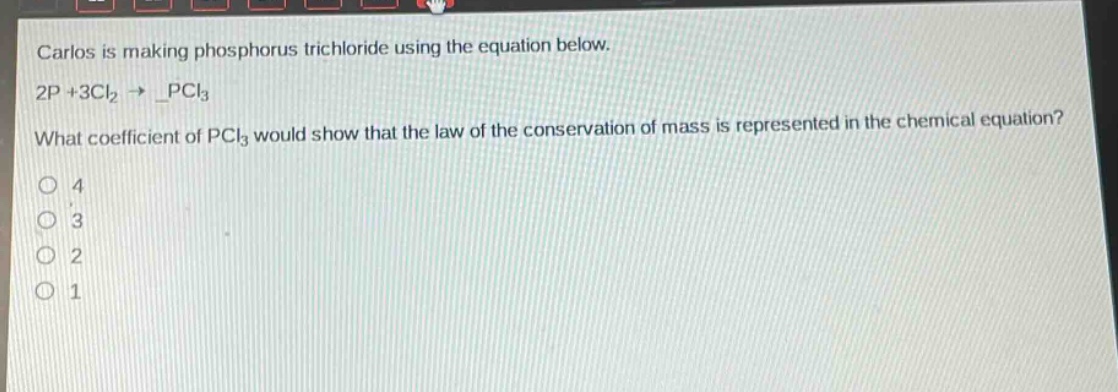
carlos is making phosphorus trichloride using the equation below. 2p + 3cl₂ → _pcl₃ what coefficient of pcl₃ would show that the law of the conservation of mass is represented in the chemical equation? 4 3 2 1
Answer
Explanation:
Step1: Count the number of phosphorus atoms
On the left - hand side of the equation (2P + 3Cl_{2}\to\underline{}PCl_{3}), the number of phosphorus ((P)) atoms is (2) (from (2P)).
Step2: Count the number of chlorine atoms
The number of chlorine ((Cl)) atoms on the left - hand side: from (3Cl_{2}), the number of (Cl) atoms is (3\times2=6).
Step3: Balance the equation
Let the coefficient of (PCl_{3}) be (x). For the (P) atoms: (x) (from (xPCl_{3})) should equal the number of (P) atoms on the left. For the (Cl) atoms: (3x) (since each (PCl_{3}) has (3) (Cl) atoms) should equal the number of (Cl) atoms on the left. If we consider the (P) atoms: we know the number of (P) atoms on the left is (2). If (x = 2) (for (PCl_{3})), then for (Cl) atoms, each (PCl_{3}) has (3) (Cl) atoms. So the number of (Cl) atoms in (2PCl_{3}) is (2\times3=6), which is equal to the number of (Cl) atoms ((3\times2 = 6)) on the left - hand side of the equation.
Answer:
2