at a certain temperature, the equilibrium constant k for the following reaction is 0.87: no2(g) + co(g) ⇌…
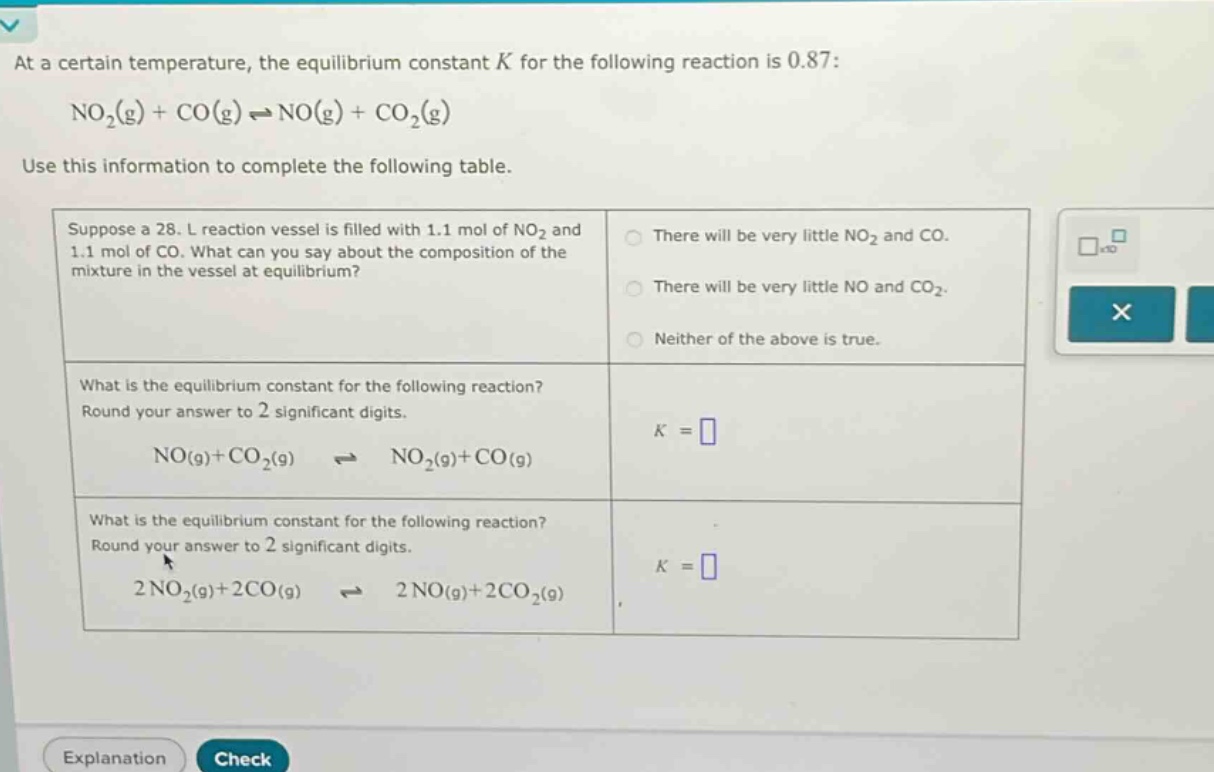
at a certain temperature, the equilibrium constant k for the following reaction is 0.87: no2(g) + co(g) ⇌ no(g) + co2(g) use this information to complete the following table. suppose a 28. l reaction vessel is filled with 1.1 mol of no2 and 1.1 mol of co. what can you say about the composition of the mixture in the vessel at equilibrium? there will be very little no2 and co. there will be very little no and co2. neither of the above is true. what is the equilibrium constant for the following reaction? round your answer to 2 significant digits. no(g)+co2(g) ⇌ no2(g)+co(g) k = what is the equilibrium constant for the following reaction? round your answer to 2 significant digits. 2no2(g)+2co(g) ⇌ 2no(g)+2co2(g) k =
Answer
Explanation:
Step1: Analyze equilibrium composition
Given $K = 0.87$ for $NO_2(g)+CO(g)\rightleftharpoons NO(g)+CO_2(g)$. Since $K$ is close to 1, neither the reactants nor the products are highly favored at equilibrium. So neither "There will be very little $NO_2$ and $CO$" nor "There will be very little $NO$ and $CO_2$" is true.
Step2: Find $K$ for reverse - reaction
For a reaction $aA + bB\rightleftharpoons cC + dD$ with equilibrium constant $K_1$ and its reverse reaction $cC + dD\rightleftharpoons aA + bB$ with equilibrium constant $K_2$, $K_2=\frac{1}{K_1}$. Given $K_1 = 0.87$ for $NO_2(g)+CO(g)\rightleftharpoons NO(g)+CO_2(g)$, for $NO(g)+CO_2(g)\rightleftharpoons NO_2(g)+CO(g)$, $K=\frac{1}{0.87}\approx1.1$.
Step3: Find $K$ for reaction with doubled coefficients
If we have a reaction $aA + bB\rightleftharpoons cC + dD$ with equilibrium constant $K_1$ and a new reaction $naA+nbB\rightleftharpoons ncC + ndD$ (where $n$ is a positive integer), $K_2 = K_1^n$. For $NO_2(g)+CO(g)\rightleftharpoons NO(g)+CO_2(g)$ with $K_1 = 0.87$, for $2NO_2(g)+2CO(g)\rightleftharpoons 2NO(g)+2CO_2(g)$, $K=(0.87)^2=0.76$.
Answer:
Neither of the above is true. $K = 1.1$ $K = 0.76$