chapter 19 carboxylic acids\nquestion 1\nwhat is the iupac name of the following compound?\na) 4 - hydroxy…
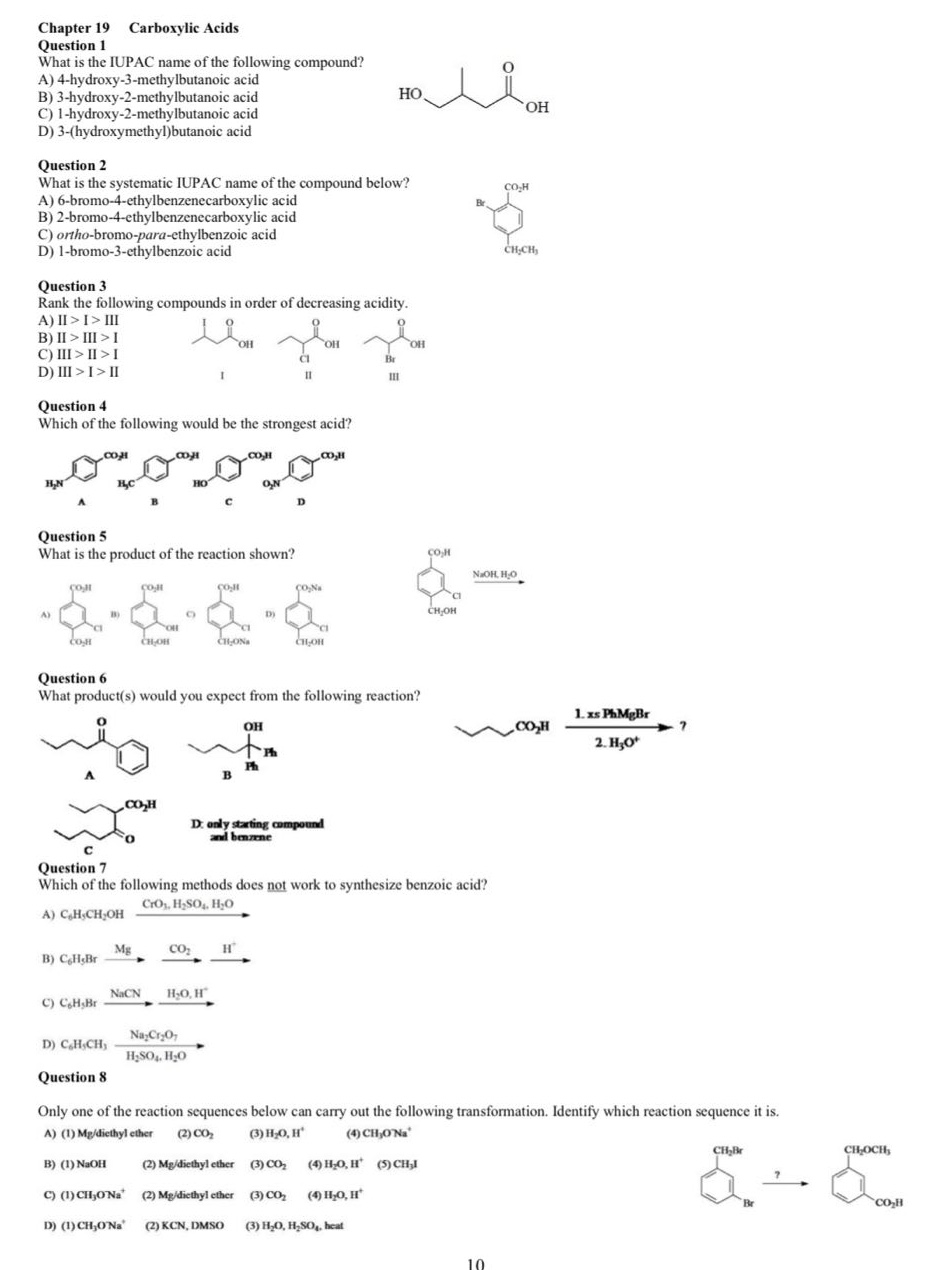
chapter 19 carboxylic acids\nquestion 1\nwhat is the iupac name of the following compound?\na) 4 - hydroxy - 3 - methylbutanoic acid\nb) 3 - hydroxy - 2 - methylbutanoic acid\nc) 1 - hydroxy - 2 - methylbutanoic acid\nd) 3 - (hydroxymethyl)butanoic acid\nquestion 2\nwhat is the systematic iupac name of the compound below?\na) 6 - bromo - 4 - ethylbenzenecarboxylic acid\nb) 2 - bromo - 4 - ethylbenzenecarboxylic acid\nc) ortho - bromo - para - ethylbenzoic acid\nd) 1 - bromo - 3 - ethylbenzoic acid\nquestion 3\nrank the following compounds in order of decreasing acidity.\na) ii > i > iii\nb) ii > iii > i\nc) iii > ii > i\nd) iii > i > ii\nquestion 4\nwhich of the following would be the strongest acid?\nquestion 5\nwhat is the product of the reaction shown?\nquestion 6\nwhat product(s) would you expect from the following reaction?\nquestion 7\nwhich of the following methods does not work to synthesize benzoic acid?\nquestion 8\nonly one of the reaction sequences below can carry out the following transformation. identify which reaction sequence it is.
Answer
Question 1
Brief Explanations:
The parent chain has 4 - carbon atoms (butanoic acid). The - OH group is on the 3 - carbon and the methyl group is on the 2 - carbon. According to IUPAC rules for naming carboxylic acids with substituents, the name is 3 - hydroxy - 2 - methylbutanoic acid.
Answer:
B. 3 - hydroxy - 2 - methylbutanoic acid
Question 2
Brief Explanations:
The parent compound is benzenecarboxylic acid. The bromine is on the 2 - position and the ethyl group is on the 4 - position relative to the carboxyl group. So the IUPAC name is 2 - bromo - 4 - ethylbenzenecarboxylic acid.
Answer:
B. 2 - bromo - 4 - ethylbenzenecarboxylic acid
Question 3
Brief Explanations:
The acidity of carboxylic acids is increased by electron - withdrawing groups. Chlorine is a stronger electron - withdrawing group than bromine. So, the acid with chlorine (II) is more acidic than the one with bromine (III), and the acid without any electron - withdrawing group (I) is the least acidic. The order is II > III > I.
Answer:
B. II > III > I
Question 4
Brief Explanations:
Electron - withdrawing groups increase the acidity of carboxylic acids. The nitro group ($NO_2$) is a strong electron - withdrawing group. Among the given options, the carboxylic acid with the nitro group (D) is the strongest acid.
Answer:
D.
Question 5
Brief Explanations:
The reaction of a carboxylic acid with a base ($NaOH$) in an alcohol ($CH_3OH$) leads to the formation of a carboxylate salt. The product is the sodium salt of the carboxylic acid with the alcohol remaining as is. So the product is the sodium salt of the given carboxylic acid.
Answer:
D.
Question 6
Brief Explanations:
The reaction of a carboxylic acid with excess Grignard reagent ($PhMgBr$) first forms a carboxylate salt and then further reacts to form a tertiary alcohol. The product is a tertiary alcohol with a phenyl group attached to the carbon that was part of the carboxyl group.
Answer:
B.
Question 7
Brief Explanations:
Oxidation of toluene ($C_6H_5CH_3$) with $Na_2Cr_2O_7$ in $H_2SO_4$ and $H_2O$ gives benzoic acid. Reaction of benzyl bromide ($C_6H_5CH_2Br$) with $Mg$, then $CO_2$ and $H^+$ gives benzoic acid. Reaction of benzyl bromide with $NaCN$ followed by hydrolysis also gives benzoic acid. Oxidation of benzyl alcohol ($C_6H_5CH_2OH$) with $CrO_3$, $H_2SO_4$ and $H_2O$ gives benzaldehyde, not benzoic acid directly.
Answer:
A.
Question 8
Brief Explanations:
First, the bromo - substituted benzene reacts with $Mg$ in diethyl ether to form a Grignard reagent. Then it reacts with $CO_2$ to form a carboxylic acid intermediate. After that, protonation with $H_2O$ and $H^+$ gives the carboxylic acid. Finally, reaction with $CH_3ONa$ and $CH_3I$ gives the ester. The correct sequence is (1) $Mg$/diethyl ether, (2) $CO_2$, (3) $H_2O$, $H^+$, (4) $CH_3ONa$, (5) $CH_3I$.
Answer:
B.