the chemical equation shows how ammonia reacts with sulfuric acid to produce ammonium sulfate.\n\n2nh₃(aq) +…
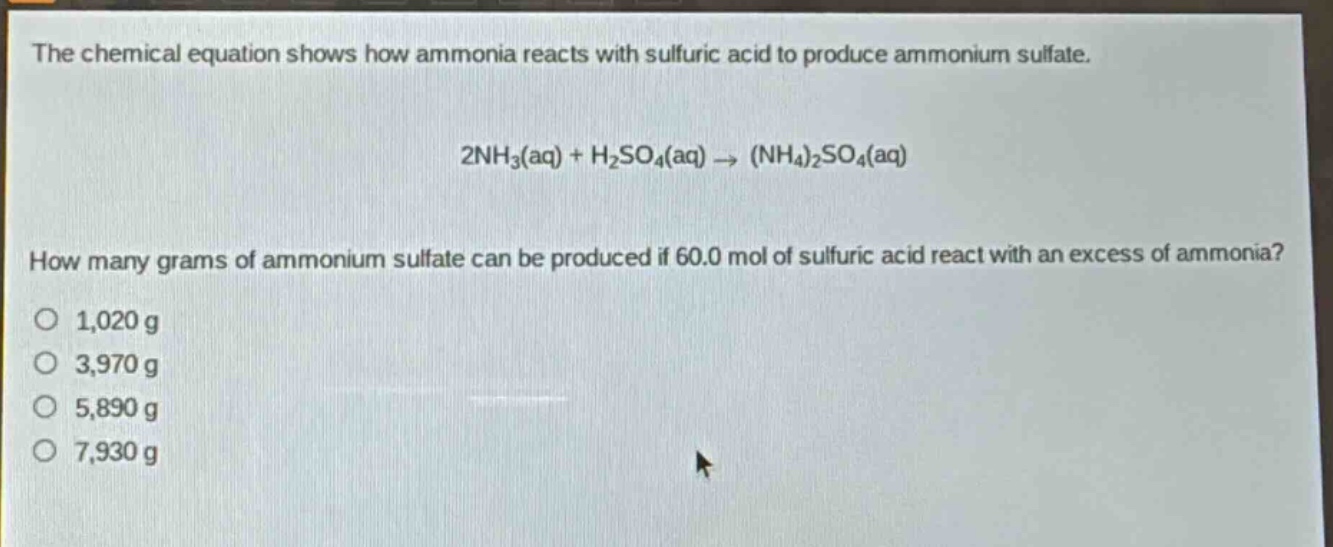
the chemical equation shows how ammonia reacts with sulfuric acid to produce ammonium sulfate.\n\n2nh₃(aq) + h₂so₄(aq) → (nh₄)₂so₄(aq)\n\nhow many grams of ammonium sulfate can be produced if 60.0 mol of sulfuric acid react with an excess of ammonia?\no 1,020 g\no 3,970 g\no 5,890 g\no 7,930 g
Answer
Explanation:
Step1: Determine mole - ratio
From the balanced equation $2NH_3(aq)+H_2SO_4(aq)\rightarrow(NH_4)_2SO_4(aq)$, the mole - ratio of $H_2SO_4$ to $(NH_4)_2SO_4$ is 1:1. So, if 60.0 mol of $H_2SO_4$ react, 60.0 mol of $(NH_4)_2SO_4$ are produced.
Step2: Calculate molar mass of $(NH_4)_2SO_4$
The molar mass of $(NH_4)_2SO_4$: $N: 14\ g/mol$, $H: 1\ g/mol$, $S: 32\ g/mol$, $O: 16\ g/mol$. $M=(2\times14)+(8\times1)+32+(4\times16)=132\ g/mol$.
Step3: Calculate mass of $(NH_4)_2SO_4$
Mass = moles×molar mass. So, mass of $(NH_4)_2SO_4=60.0\ mol\times132\ g/mol = 7920\ g\approx7930\ g$.
Answer:
D. 7,930 g