in a chemical reaction occurring in an open beaker, the reactants have a mass of 10.0 g and contain 1000 j…
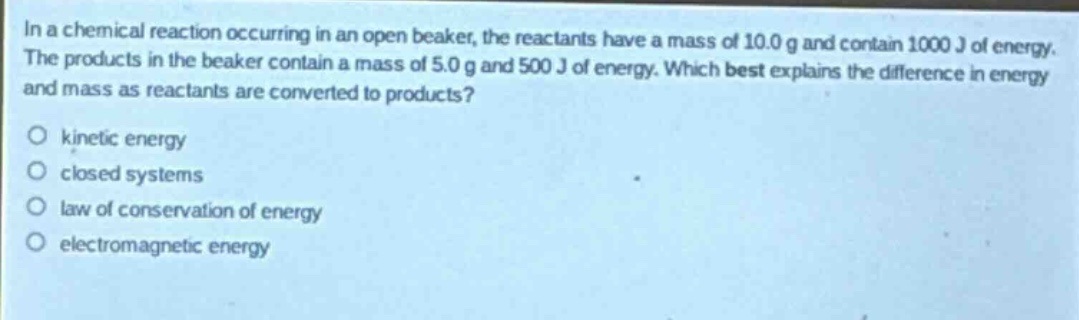
in a chemical reaction occurring in an open beaker, the reactants have a mass of 10.0 g and contain 1000 j of energy. the products in the beaker contain a mass of 5.0 g and 500 j of energy. which best explains the difference in energy and mass as reactants are converted to products?\no kinetic energy\no closed systems\no law of conservation of energy\no electromagnetic energy
Answer
Brief Explanations:
The law of conservation of energy states that energy is neither created nor destroyed in a chemical reaction. In an open - beaker reaction, the difference in mass and energy between reactants and products can be explained by energy being transferred to the surroundings. Kinetic energy and electromagnetic energy do not fully explain the overall mass - energy difference. Closed systems are not relevant here as the reaction is in an open beaker. The law of conservation of energy accounts for the energy change as energy is lost to the environment.
Answer:
law of conservation of energy