a chemist has 200 ml of a 10% sucrose solution. she adds (x) ml of a 40% sucrose solution. the percent…
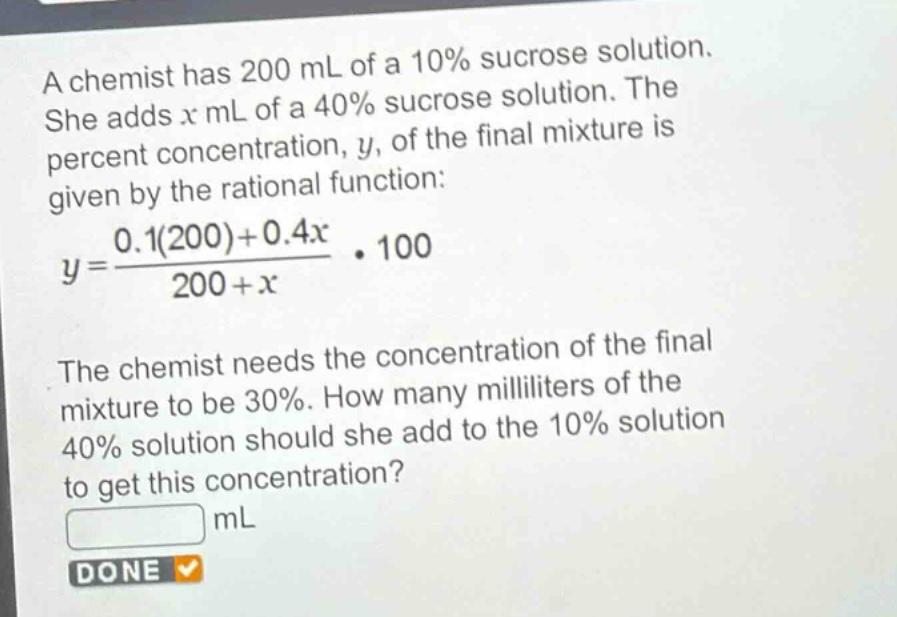
a chemist has 200 ml of a 10% sucrose solution. she adds (x) ml of a 40% sucrose solution. the percent concentration, (y), of the final mixture is given by the rational function: (y = \frac{0.1(200)+0.4x}{200 + x}cdot100). the chemist needs the concentration of the final mixture to be 30%. how many milliliters of the 40% solution should she add to the 10% solution to get this concentration? ml
Answer
Answer:
400
Explanation:
Step1: Set up the equation
We know that $y = 30$, so $30=\frac{0.1(200)+0.4x}{200 + x}\times100$. First, divide both sides by 100: $\frac{30}{100}=\frac{0.1(200)+0.4x}{200 + x}$, which simplifies to $0.3=\frac{20 + 0.4x}{200 + x}$.
Step2: Cross - multiply
$0.3(200 + x)=20 + 0.4x$. Expand the left - hand side: $60+0.3x=20 + 0.4x$.
Step3: Solve for x
Subtract $0.3x$ from both sides: $60=20 + 0.4x-0.3x$. Then $60=20 + 0.1x$. Subtract 20 from both sides: $0.1x=60 - 20=40$. Divide both sides by 0.1: $x = 400$.