a chemist has 500 ml of a 30% acid solution. she adds x milliliters of a 10% acid solution. which statement…
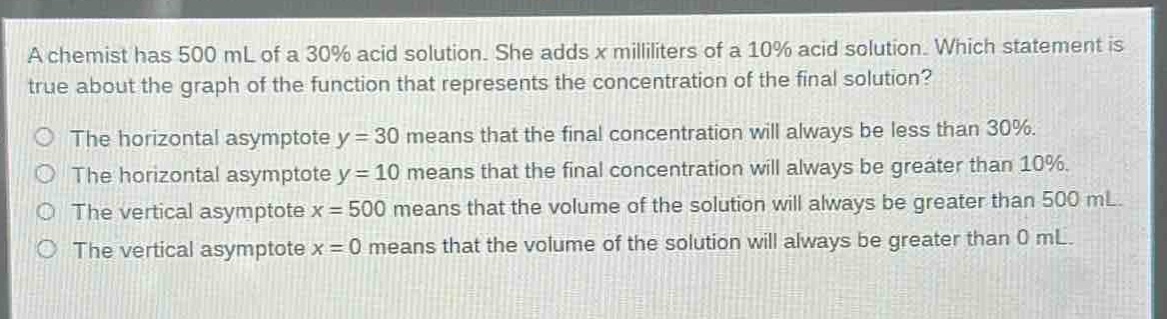
a chemist has 500 ml of a 30% acid solution. she adds x milliliters of a 10% acid solution. which statement is true about the graph of the function that represents the concentration of the final solution?\nthe horizontal asymptote y = 30 means that the final concentration will always be less than 30%.\nthe horizontal asymptote y = 10 means that the final concentration will always be greater than 10%.\nthe vertical asymptote x = 500 means that the volume of the solution will always be greater than 500 ml.\nthe vertical asymptote x = 0 means that the volume of the solution will always be greater than 0 ml.
Answer
Explanation:
Step1: Find the concentration formula
The amount of acid in the initial 500 - mL 30% solution is (0.3\times500 = 150) mL. The amount of acid in (x) mL of 10% solution is (0.1x) mL. The total volume of the final solution is ((500 + x)) mL. The concentration (C(x)) of the final solution is (C(x)=\frac{150+0.1x}{500 + x}).
Step2: Analyze horizontal asymptotes
We find the horizontal asymptote by taking the limit as (x\to\pm\infty). (\lim_{x\to\infty}\frac{150 + 0.1x}{500+x}=\lim_{x\to\infty}\frac{\frac{150}{x}+0.1}{\frac{500}{x}+1}=0.1 = 10%). This means that as we add more and more of the 10% - acid solution, the concentration of the final solution approaches 10%. So the final concentration will always be greater than 10%.
Step3: Analyze vertical asymptotes
The function (C(x)=\frac{150+0.1x}{500 + x}) is undefined when the denominator is zero. Setting (500 + x=0), we get (x=- 500). But in the context of adding volume ((x\geq0)), the vertical - asymptote analysis in the given options is incorrect.
Answer:
The horizontal asymptote (y = 10) means that the final concentration will always be greater than 10%.