a chemist measures the energy change δh during the following reaction: c₃h₈(g)+5o₂(g)→3co₂(g)+4h₂o(l) δh =…
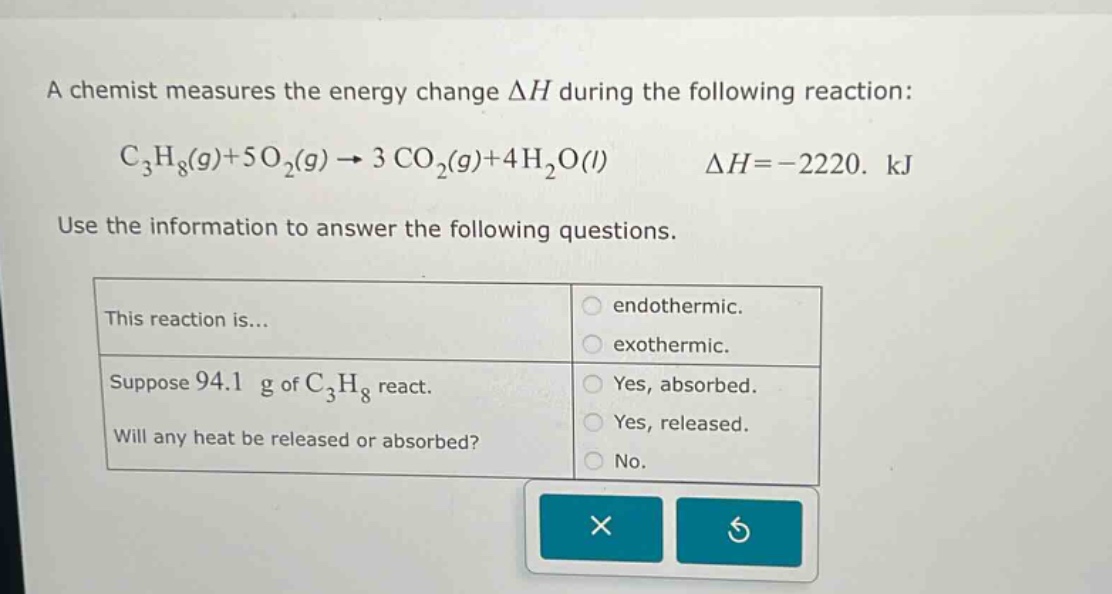
a chemist measures the energy change δh during the following reaction: c₃h₈(g)+5o₂(g)→3co₂(g)+4h₂o(l) δh = -2220. kj use the information to answer the following questions. this reaction is... endothermic. exothermic. suppose 94.1 g of c₃h₈ react. will any heat be released or absorbed? yes, absorbed. yes, released. no.
Answer
Explanation:
Step1: Determine reaction type
If $\Delta H<0$, the reaction is exothermic. Given $\Delta H = - 2220\ kJ<0$, so it is exothermic.
Step2: Analyze heat change for given mass
Since the reaction is exothermic, when reactants react, heat is released.
Answer:
This reaction is...: exothermic. Suppose 94.1 g of $C_3H_8$ react. Will any heat be released or absorbed?: Yes, released.