a chemist is studying the properties of a gas under various conditions. he observes that when the gas is at…
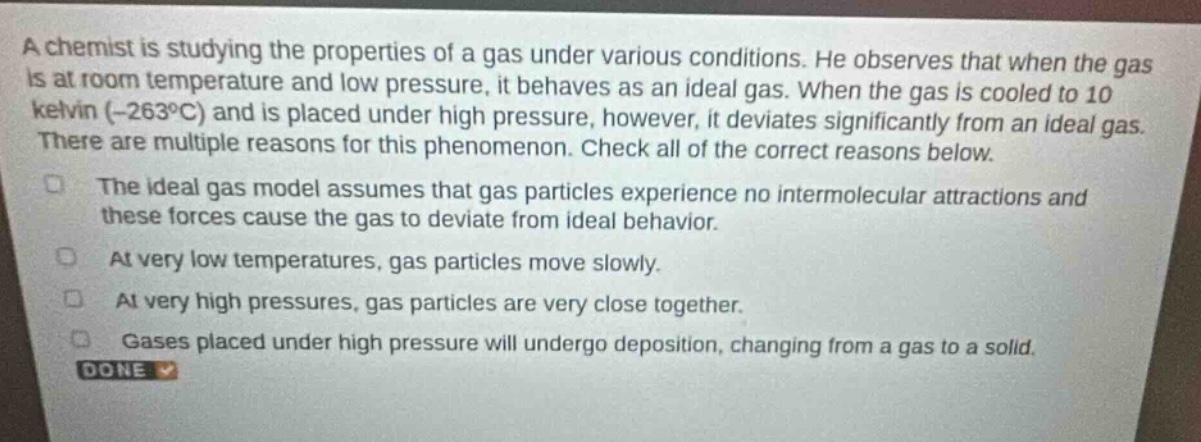
a chemist is studying the properties of a gas under various conditions. he observes that when the gas is at room temperature and low pressure, it behaves as an ideal gas. when the gas is cooled to 10 kelvin (-263°c) and is placed under high pressure, however, it deviates significantly from an ideal gas. there are multiple reasons for this phenomenon. check all of the correct reasons below.\nthe ideal gas model assumes that gas particles experience no intermolecular attractions and these forces cause the gas to deviate from ideal behavior.\nat very low temperatures, gas particles move slowly.\nat very high pressures, gas particles are very close together.\ngases placed under high pressure will undergo deposition, changing from a gas to a solid.\ndone
Answer
Brief Explanations:
The ideal gas model has assumptions like no intermolecular forces. At low - T, particles move slowly and at high - P, they are close, both of which violate ideal gas assumptions. Deposition is not a reason for deviation from ideal gas behavior in this context as the question is about deviation, not phase change to solid.
Answer:
The ideal gas model assumes that gas particles experience no intermolecular attractions and these forces cause the gas to deviate from ideal behavior. At very low temperatures, gas particles move slowly. At very high pressures, gas particles are very close together.