when chemists convert ethene (c2h2) to ethanol (ch3ch2oh), they have a mixture of the two gaseous…
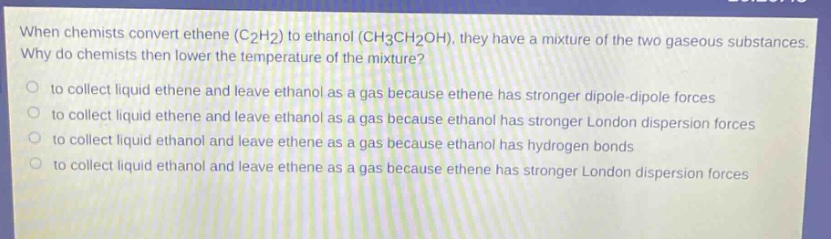
when chemists convert ethene (c2h2) to ethanol (ch3ch2oh), they have a mixture of the two gaseous substances. why do chemists then lower the temperature of the mixture? to collect liquid ethene and leave ethanol as a gas because ethene has stronger dipole - dipole forces to collect liquid ethene and leave ethanol as a gas because ethanol has stronger london dispersion forces to collect liquid ethanol and leave ethene as a gas because ethanol has hydrogen bonds to collect liquid ethanol and leave ethene as a gas because ethene has stronger london dispersion forces
Answer
Brief Explanations:
Ethanol has hydrogen - bonding due to the -OH group. Hydrogen bonds are stronger intermolecular forces compared to London dispersion forces in ethene. Lowering the temperature will cause the substance with stronger intermolecular forces (ethanol) to condense into a liquid first while ethene remains as a gas.
Answer:
to collect liquid ethanol and leave ethene as a gas because ethanol has hydrogen bonds