h(g) + cl(g) → hcl(g)\nthe formation of hcl(g) from its atoms is represented by the equation above. which of…
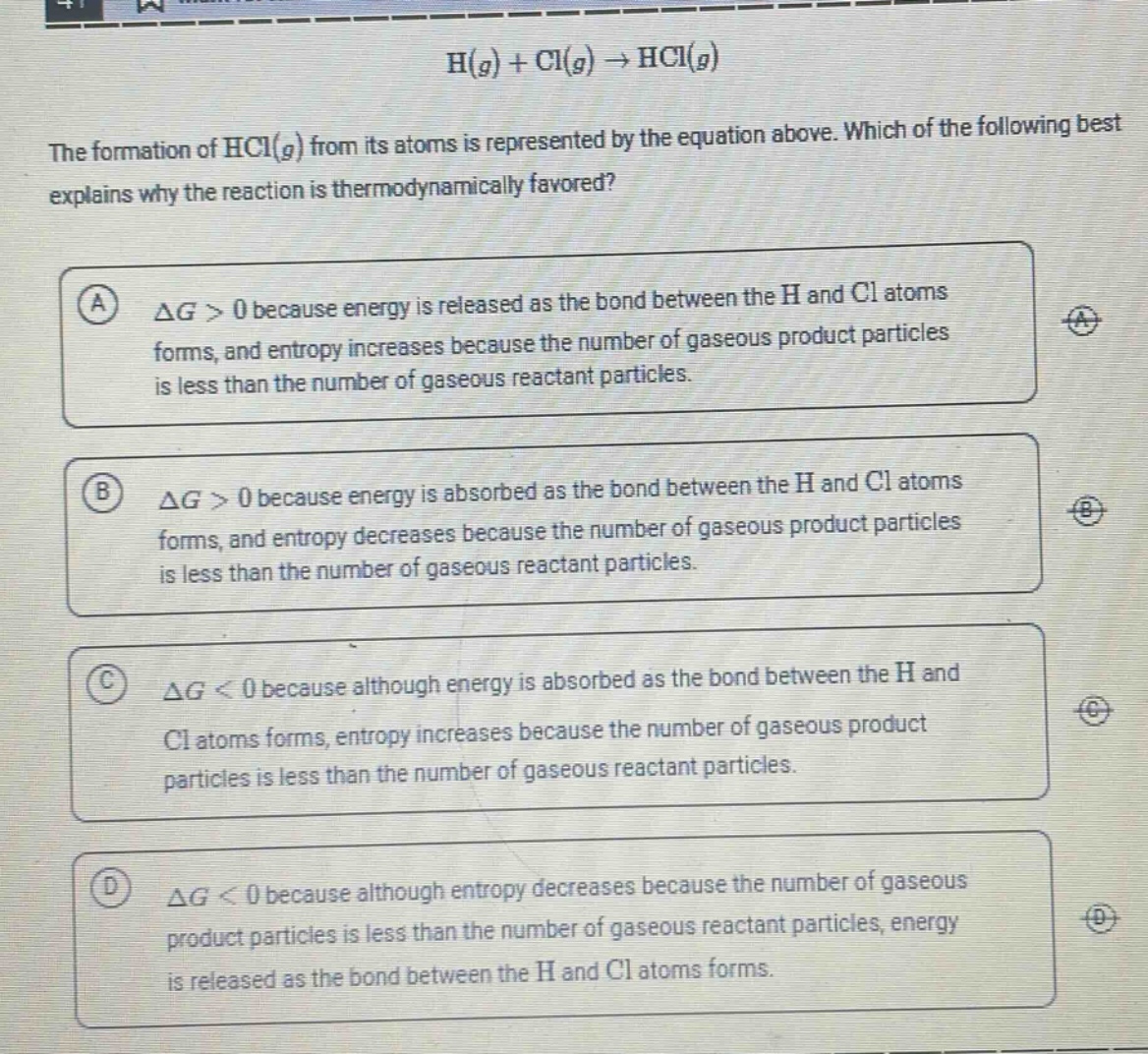
h(g) + cl(g) → hcl(g)\nthe formation of hcl(g) from its atoms is represented by the equation above. which of the following best explains why the reaction is thermodynamically favored?\na δg > 0 because energy is released as the bond between the h and cl atoms forms, and entropy increases because the number of gaseous product particles is less than the number of gaseous reactant particles.\nb δg > 0 because energy is absorbed as the bond between the h and cl atoms forms, and entropy decreases because the number of gaseous product particles is less than the number of gaseous reactant particles.\nc δg < 0 because although energy is absorbed as the bond between the h and cl atoms forms, entropy increases because the number of gaseous product particles is less than the number of gaseous reactant particles.\nd δg < 0 because although entropy decreases because the number of gaseous product particles is less than the number of gaseous reactant particles, energy is released as the bond between the h and cl atoms forms.
Answer
Brief Explanations:
A reaction is thermodynamically favored when $\Delta G<0$. When the bond between $H$ and $Cl$ atoms forms, energy is released (exothermic process). Also, the number of gaseous product particles (1) is less than the number of gaseous reactant particles (2), so entropy decreases. But the energy - release from bond - formation outweighs the entropy decrease, making $\Delta G < 0$.
Answer:
D. $\Delta G<0$ because although entropy decreases because the number of gaseous product particles is less than the number of gaseous reactant particles, energy is released as the bond between the $H$ and $Cl$ atoms forms.