click the blue words to correct the following statements. atoms are tiny pieces of matter that make up all…
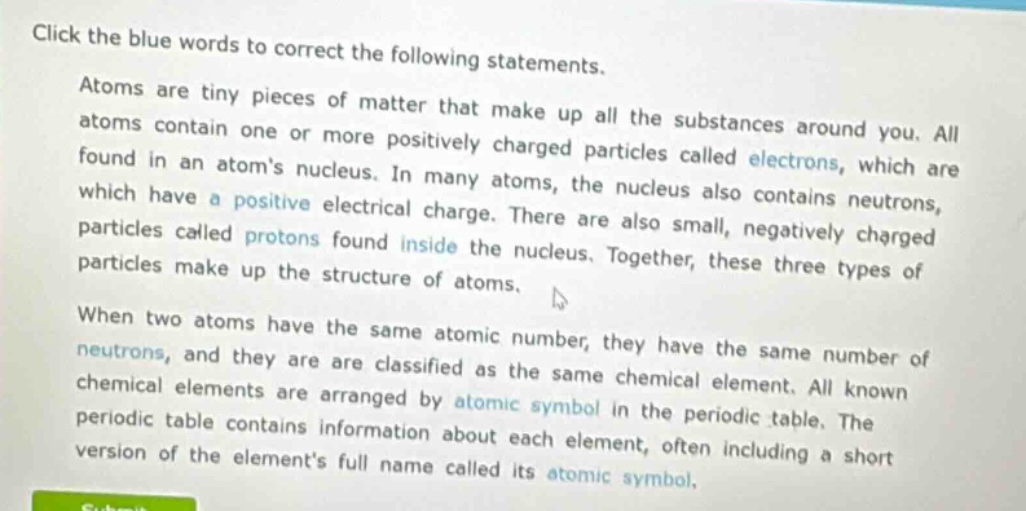
click the blue words to correct the following statements. atoms are tiny pieces of matter that make up all the substances around you. all atoms contain one or more positively charged particles called electrons, which are found in an atoms nucleus. in many atoms, the nucleus also contains neutrons, which have a positive electrical charge. there are also small, negatively charged particles called protons found inside the nucleus. together, these three types of particles make up the structure of atoms. when two atoms have the same atomic number, they have the same number of neutrons, and they are are classified as the same chemical element. all known chemical elements are arranged by atomic symbol in the periodic table. the periodic table contains information about each element, often including a short version of the elements full name called its atomic symbol.
Answer
Brief Explanations:
- Positively - charged particles in an atom's nucleus are protons, not electrons. Electrons are negatively - charged and orbit the nucleus.
- Atoms with the same atomic number have the same number of protons, not neutrons, and are of the same chemical element.
- Chemical elements are arranged by atomic number in the periodic table, not atomic symbol. The atomic symbol is a short version of the element's name.
Answer:
- Replace "electrons" with "protons" in "All atoms contain one or more positively charged particles called electrons, which are found in an atom's nucleus."
- Replace "neutrons" with "protons" in "When two atoms have the same atomic number, they have the same number of neutrons, and they are classified as the same chemical element."
- Replace "atomic symbol" with "atomic number" in "All known chemical elements are arranged by atomic symbol in the periodic table."