compare the models of a chlorine atom versus a chlorine ion. how are the two different? choose all that…
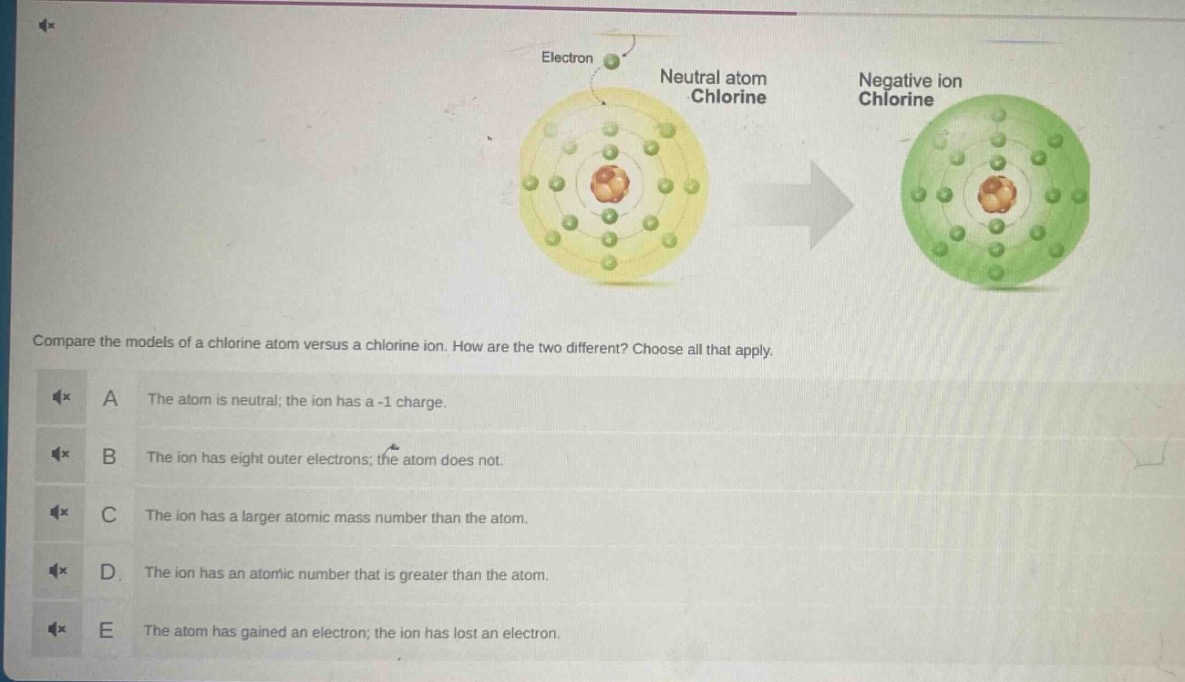
compare the models of a chlorine atom versus a chlorine ion. how are the two different? choose all that apply.\na the atom is neutral; the ion has a -1 charge.\nb the ion has eight outer electrons; the atom does not.\nc the ion has a larger atomic mass number than the atom.\nd the ion has an atomic number that is greater than the atom.\ne the atom has gained an electron; the ion has lost an electron.
Answer
Brief Explanations:
- A neutral atom has equal number of protons and electrons. A negative ion is formed when an atom gains an electron, so the chlorine - ion has a - 1 charge while the chlorine atom is neutral (A is correct).
- Chlorine atom has 7 outer - shell electrons. When it forms a negative ion, it gains an electron to have 8 outer - shell electrons (B is correct).
- Atomic mass number is the sum of protons and neutrons. Gaining an electron does not change the number of protons and neutrons, so the atomic mass number of the atom and the ion is the same (C is incorrect).
- Atomic number is the number of protons, which does not change when an atom forms an ion. So the atomic number of the chlorine atom and the chlorine ion is the same (D is incorrect).
- A negative ion is formed when an atom gains an electron. Here, the chlorine atom gains an electron to form the negative chlorine ion, not the other way around (E is incorrect).
Answer:
A. The atom is neutral; the ion has a - 1 charge. B. The ion has eight outer electrons; the atom does not.