complete the table below by deciding whether a precipitate forms when aqueous solutions a and b are mixed…
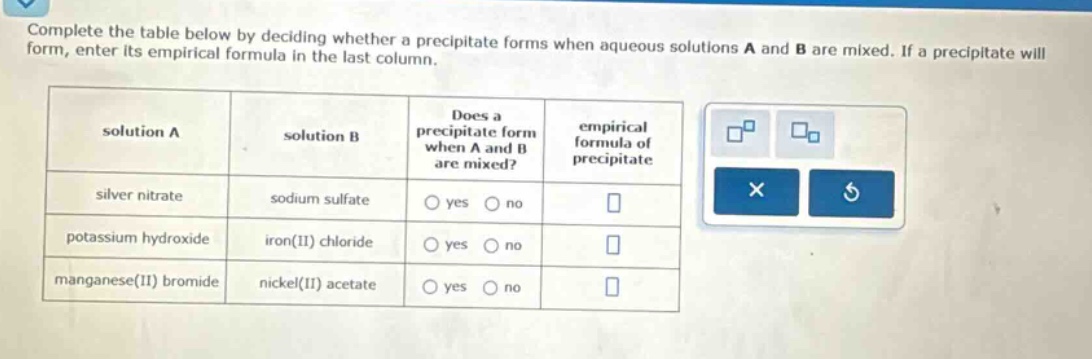
complete the table below by deciding whether a precipitate forms when aqueous solutions a and b are mixed. if a precipitate will form, enter its empirical formula in the last column. solution a solution b does a precipitate form when a and b are mixed? empirical formula of precipitate silver nitrate sodium sulfate yes no potassium hydroxide iron(ii) chloride yes no manganese(ii) bromide nickel(ii) acetate yes no
Answer
Answer:
| solution A | solution B | Does a precipitate form when A and B are mixed? | empirical formula of precipitate |
|---|---|---|---|
| silver nitrate | sodium sulfate | yes | $\ce{Ag2SO4}$ |
| potassium hydroxide | iron(II) chloride | yes | $\ce{Fe(OH)2}$ |
| manganese(II) bromide | nickel(II) acetate | no |
Explanation:
Step1: Write reaction for silver nitrate and sodium sulfate
$\ce{2AgNO3(aq) + Na2SO4(aq)\rightarrow Ag2SO4(s)+ 2NaNO3(aq)}$; silver sulfate is insoluble.
Step2: Write reaction for potassium hydroxide and iron(II) chloride
$\ce{2KOH(aq)+FeCl2(aq)\rightarrow Fe(OH)2(s) + 2KCl(aq)}$; iron - (II) hydroxide is insoluble.
Step3: Write reaction for manganese(II) bromide and nickel(II) acetate
$\ce{MnBr2(aq)+Ni(CH3COO)2(aq)\rightarrow Mn(CH3COO)2(aq)+NiBr2(aq)}$; all products are soluble.