which compound most likely contains polar covalent bonds?\no nacl\no aif3\no br2\no nf3
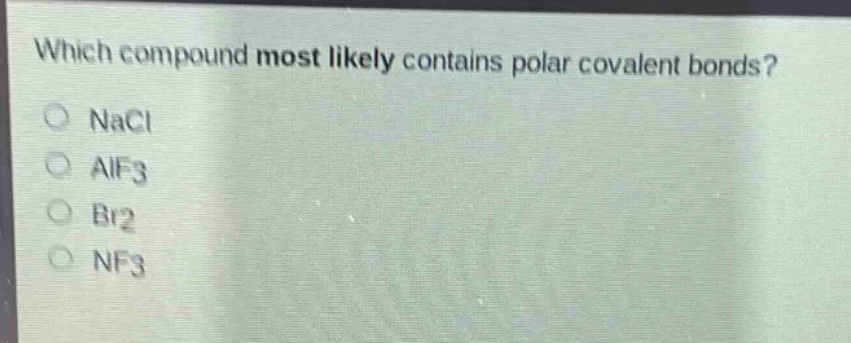
which compound most likely contains polar covalent bonds?\no nacl\no aif3\no br2\no nf3
Answer
Explanation:
Step1: Recall bond - type criteria
Ionic bonds form between a metal and a non - metal with large electronegativity differences. Covalent bonds form between non - metals. Polar covalent bonds have an electronegativity difference between the bonded atoms.
Step2: Analyze NaCl
NaCl is an ionic compound. Sodium (Na) is a metal and chlorine (Cl) is a non - metal. The bond is ionic, not polar covalent.
Step3: Analyze AlF3
AlF3 is an ionic compound. Aluminum (Al) is a metal and fluorine (F) is a non - metal. The bond is ionic, not polar covalent.
Step4: Analyze Br2
Br2 is a non - polar covalent compound. It consists of two bromine atoms with the same electronegativity, so the bond is non - polar covalent.
Step5: Analyze NF3
Nitrogen (N) and fluorine (F) are non - metals. Fluorine is more electronegative than nitrogen. There is an electronegativity difference between N and F, so the N - F bonds in NF3 are polar covalent.
Answer:
NF3