consider the chemical equation.\n2h₂ + o₂ → 2h₂o\nwhat is the percent yield of h₂o if 87.0 g of h₂o is…
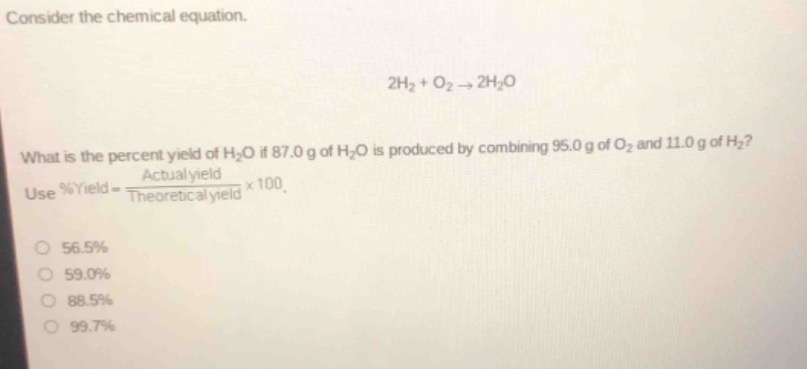
consider the chemical equation.\n2h₂ + o₂ → 2h₂o\nwhat is the percent yield of h₂o if 87.0 g of h₂o is produced by combining 95.0 g of o₂ and 11.0 g of h₂? use %yield = \\frac{actual yield}{theoretical yield}×100.\n56.5%\n59.0%\n88.5%\n99.7%
Answer
Explanation:
Step1: Determine the limiting reactant
First, find the moles of $H_2$ and $O_2$. Molar mass of $H_2$ is $2.02\ g/mol$, molar mass of $O_2$ is $32.00\ g/mol$. Moles of $H_2=\frac{11.0\ g}{2.02\ g/mol}=5.45\ mol$. Moles of $O_2=\frac{95.0\ g}{32.00\ g/mol}=2.97\ mol$. From the balanced equation $2H_2 + O_2\rightarrow2H_2O$, the mole - ratio of $H_2$ to $O_2$ is $2:1$. For $2.97\ mol$ of $O_2$, we need $2\times2.97 = 5.94\ mol$ of $H_2$, but we have only $5.45\ mol$ of $H_2$. So, $H_2$ is the limiting reactant.
Step2: Calculate the theoretical yield of $H_2O$
From the balanced equation, the mole - ratio of $H_2$ to $H_2O$ is $1:1$. Moles of $H_2O$ produced theoretically = moles of $H_2$ (limiting reactant) = $5.45\ mol$. Molar mass of $H_2O$ is $18.02\ g/mol$. Theoretical yield of $H_2O=5.45\ mol\times18.02\ g/mol = 98.2\ g$.
Step3: Calculate the percent yield
Percent yield = $\frac{\text{Actual yield}}{\text{Theoretical yield}}\times100$. Actual yield = $87.0\ g$, theoretical yield = $98.2\ g$. Percent yield=$\frac{87.0\ g}{98.2\ g}\times100 = 88.6%$ (approx. $88.5%$ considering rounding differences in the options).
Answer:
88.5%