consider the chemical equation in equilibrium.\n\nch₄(g) + h₂o(g) ⇌ co(g) + 3h₂(g)\n\nwhat will happen to…
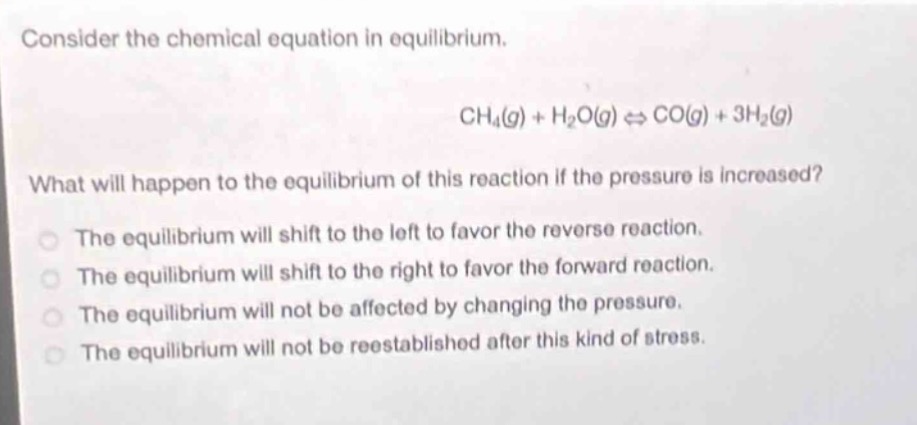
consider the chemical equation in equilibrium.\n\nch₄(g) + h₂o(g) ⇌ co(g) + 3h₂(g)\n\nwhat will happen to the equilibrium of this reaction if the pressure is increased?\n\nthe equilibrium will shift to the left to favor the reverse reaction.\nthe equilibrium will shift to the right to favor the forward reaction.\nthe equilibrium will not be affected by changing the pressure.\nthe equilibrium will not be reestablished after this kind of stress.
Answer
Explanation:
Step1: Analyze moles of gas on each side
On the left - hand side, there are (1 + 1=2) moles of gas ((1) mole of (CH_4) and (1) mole of (H_2O)). On the right - hand side, there are (1+3 = 4) moles of gas ((1) mole of (CO) and (3) moles of (H_2)).
Step2: Apply Le - Chatelier's principle
According to Le - Chatelier's principle, when the pressure is increased, the equilibrium will shift in the direction that reduces the number of moles of gas. Since there are fewer moles of gas on the left - hand side, the equilibrium will shift to the left to favor the reverse reaction.
Answer:
The equilibrium will shift to the left to favor the reverse reaction.