consider the chemical equations shown here. no(g)+o3(g)→no2(g)+o2(g) δh1 = -198.9 kj 3/2 o2(g)→o3(g) δh2 =…
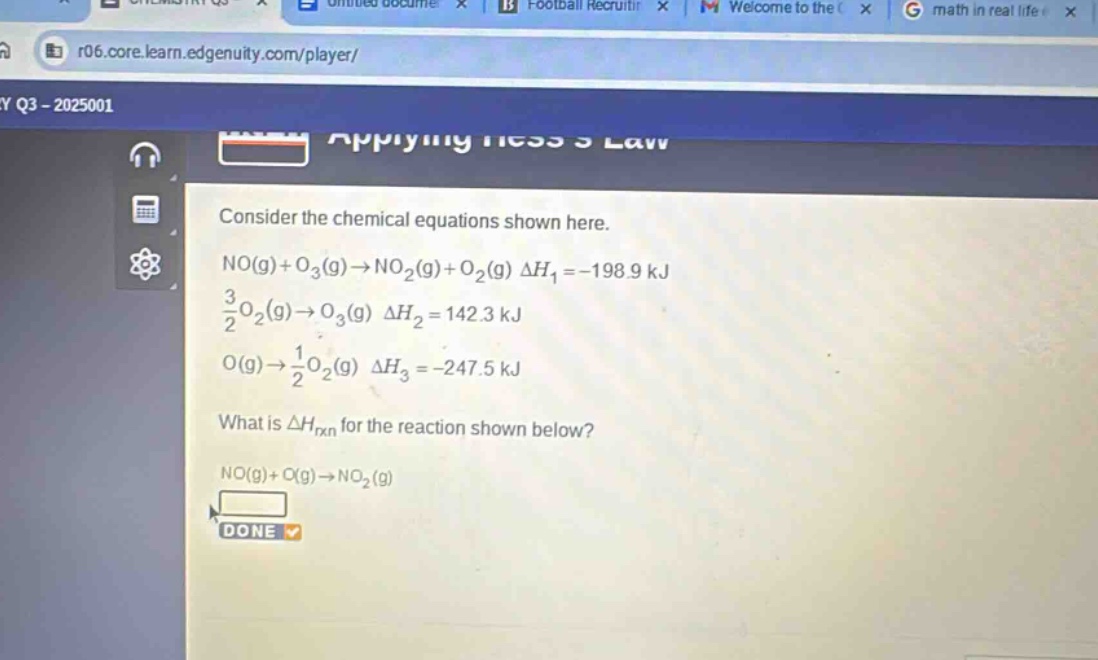
consider the chemical equations shown here. no(g)+o3(g)→no2(g)+o2(g) δh1 = -198.9 kj 3/2 o2(g)→o3(g) δh2 = 142.3 kj o(g)→1/2 o2(g) δh3 = -247.5 kj what is δhrxn for the reaction shown below? no(g)+o(g)→no2(g)
Answer
Explanation:
Step1: Identify target reaction components
We have the target reaction $NO(g)+O(g)\rightarrow NO_2(g)$. We need to manipulate the given reactions to get this.
Step2: Manipulate given reactions
The first reaction is $NO(g)+O_3(g)\rightarrow NO_2(g)+O_2(g)\ \Delta H_1 = - 198.9\ kJ$. The second reaction $\frac{3}{2}O_2(g)\rightarrow O_3(g)\ \Delta H_2=142.3\ kJ$. The third reaction $O(g)\rightarrow\frac{1}{2}O_2(g)\ \Delta H_3=-247.5\ kJ$. Adding these three reactions together: $(NO(g)+O_3(g)\rightarrow NO_2(g)+O_2(g))+(\frac{3}{2}O_2(g)\rightarrow O_3(g))+(O(g)\rightarrow\frac{1}{2}O_2(g))$ On the left - hand side, $O_3(g)$ and $\frac{3}{2}O_2(g)$ and $\frac{1}{2}O_2(g)$ cancel out appropriately to give $NO(g) + O(g)$. On the right - hand side, we get $NO_2(g)$.
Step3: Calculate $\Delta H_{rxn}$
According to Hess's law, $\Delta H_{rxn}=\Delta H_1+\Delta H_2+\Delta H_3$. $\Delta H_{rxn}=-198.9 + 142.3-247.5$ $\Delta H_{rxn}=-304.1\ kJ$
Answer:
$-304.1\ kJ$