consider the chemical reaction below.\nzn(s) + 2h+(aq) → zn2+(aq) + h2(g)\nwhich half - reaction correctly…
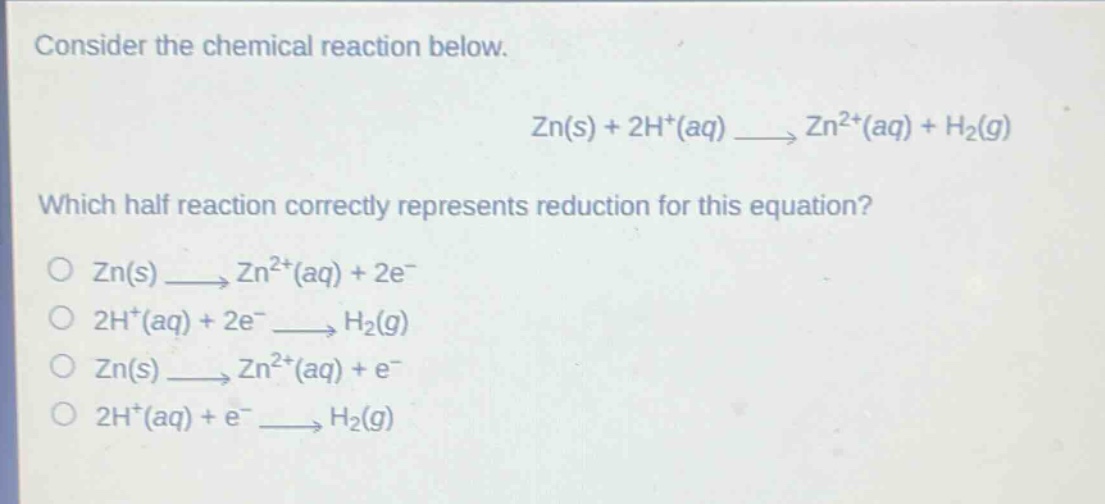
consider the chemical reaction below.\nzn(s) + 2h+(aq) → zn2+(aq) + h2(g)\nwhich half - reaction correctly represents reduction for this equation?\no zn(s) → zn2+(aq) + 2e-\no 2h+(aq) + 2e- → h2(g)\no zn(s) → zn2+(aq) + e-\no 2h+(aq) + e- → h2(g)
Answer
Explanation:
Step1: Recall reduction definition
Reduction is the gain of electrons.
Step2: Analyze each half - reaction
In the reaction $Zn(s)+2H^{+}(aq)\longrightarrow Zn^{2 +}(aq)+H_{2}(g)$, zinc loses electrons (oxidation). Hydrogen ions gain electrons. The correct half - reaction for reduction is when hydrogen ions gain electrons to form hydrogen gas. The balanced half - reaction for the reduction of hydrogen ions is $2H^{+}(aq)+2e^{-}\longrightarrow H_{2}(g)$.
Answer:
$2H^{+}(aq)+2e^{-}\longrightarrow H_{2}(g)$ (the second option in the multiple - choice list)