consider the combustion reaction for acetylene.\n\n2c₂h₂(l) + 5o₂(g) → 4co₂(g) + 2h₂o(g)\n\nif the acetylene…
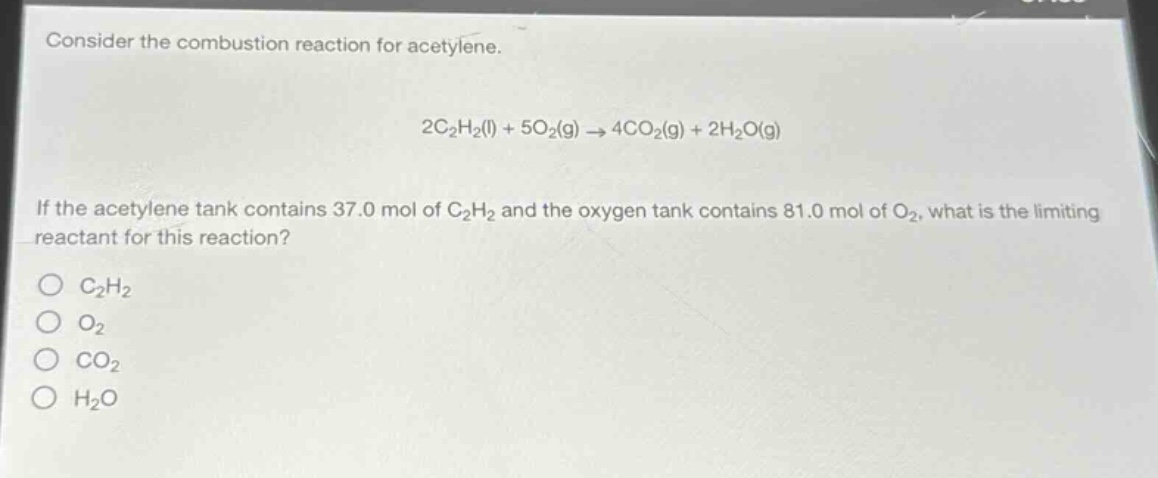
consider the combustion reaction for acetylene.\n\n2c₂h₂(l) + 5o₂(g) → 4co₂(g) + 2h₂o(g)\n\nif the acetylene tank contains 37.0 mol of c₂h₂ and the oxygen tank contains 81.0 mol of o₂, what is the limiting reactant for this reaction?\n\no c₂h₂\no o₂\no co₂\no h₂o
Answer
Explanation:
Step1: Determine moles of $O_2$ needed for complete reaction of $C_2H_2$
From the balanced equation $2C_2H_2(l)+5O_2(g)\rightarrow4CO_2(g) + 2H_2O(g)$, the mole - ratio of $C_2H_2$ to $O_2$ is $2:5$. Given $n_{C_2H_2}=37.0$ mol. The moles of $O_2$ required for complete reaction of $C_2H_2$ is $n_{O_2\ required}=\frac{5}{2}\times n_{C_2H_2}=\frac{5}{2}\times37.0$ mol$ = 92.5$ mol.
Step2: Compare required and available moles of $O_2$
The available moles of $O_2$ is $n_{O_2\ available}=81.0$ mol. Since $n_{O_2\ available}(81.0\ mol)<n_{O_2\ required}(92.5\ mol)$, oxygen is the limiting reactant.
Answer:
B. $O_2$