consider the electron configuration.\n1s: ↑↓\n2s: ↑↓\n2p: ↑↓↑↓↑↓\n3s: ↑↓\n3p: ↑↓↑↓↑\nwhich element has this…
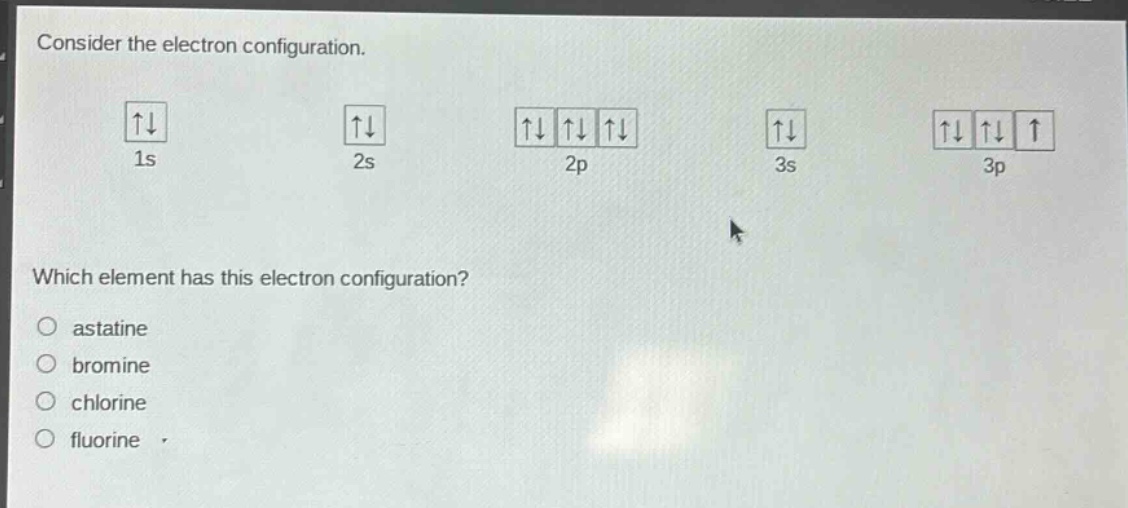
consider the electron configuration.\n1s: ↑↓\n2s: ↑↓\n2p: ↑↓↑↓↑↓\n3s: ↑↓\n3p: ↑↓↑↓↑\nwhich element has this electron configuration?\nastatine\nbromine\nchlorine\nfluorine
Answer
Explanation:
Step1: Count the total electrons
Count the number of electrons in each orbital. 1s has 2 electrons, 2s has 2 electrons, 2p has 5 electrons, 3s has 2 electrons and 3p has 5 electrons. So, $2 + 2+5 + 2+5=16$ electrons.
Step2: Identify the element
The atomic number of an element is equal to the number of electrons in a neutral atom. Chlorine has an atomic number of 17. Fluorine has an atomic number of 9. Bromine has an atomic number of 35. Astatine has an atomic number of 85. The electron - configuration shown corresponds to an element with 17 electrons. Chlorine has the electron - configuration $1s^{2}2s^{2}2p^{6}3s^{2}3p^{5}$.
Answer:
chlorine