consider the electron configuration.\n1s: ↑↓\n2s: ↑↓\n2p: ↑↓↑↓↑↓\n3s: ↑↓\n3p: ↑↓↑↓↑\nwhich element has this…
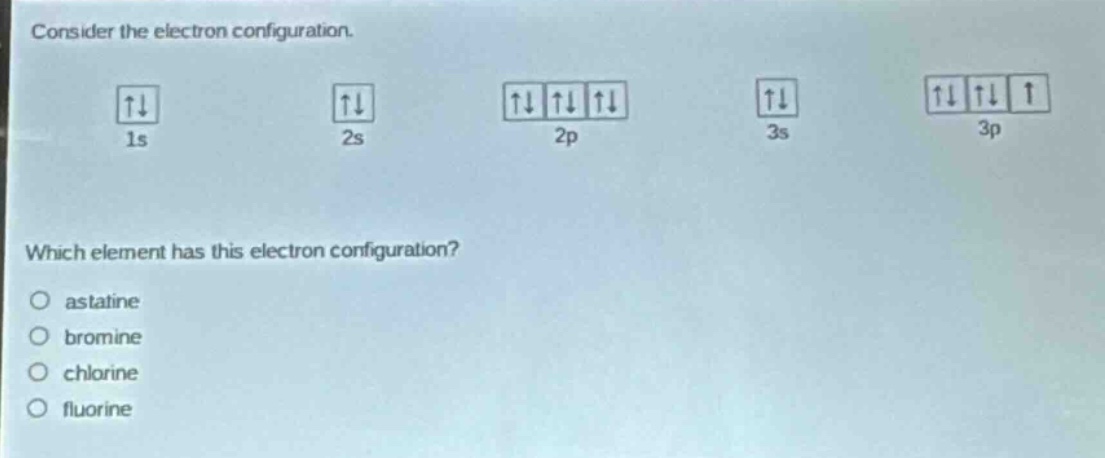
consider the electron configuration.\n1s: ↑↓\n2s: ↑↓\n2p: ↑↓↑↓↑↓\n3s: ↑↓\n3p: ↑↓↑↓↑\nwhich element has this electron configuration?\no astatine\no bromine\no chlorine\no fluorine
Answer
Explanation:
Step1: Count total electrons
Count the number of electrons in each orbital. 1s has 2 electrons, 2s has 2 electrons, 2p has 6 electrons, 3s has 2 electrons and 3p has 5 electrons. So, $2 + 2+6 + 2+5=17$.
Step2: Identify element
The atomic number of an element is equal to the number of electrons in a neutral atom. Chlorine has an atomic number of 17.
Answer:
C. chlorine