consider the following chemical reaction of bromothymol blue indicator. it appears yellow in undissociated…
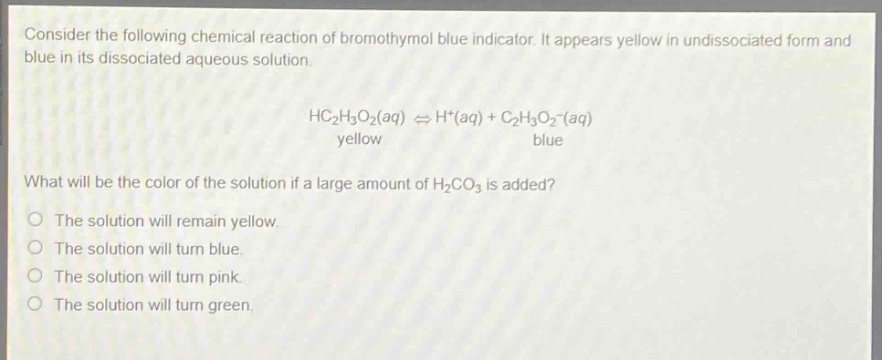
consider the following chemical reaction of bromothymol blue indicator. it appears yellow in undissociated form and blue in its dissociated aqueous solution.\n\n \begin{align*} \text{hc}_{2}\text{h}_{3}\text{o}_{2}(aq)&\rightleftharpoons\text{h}^{+}(aq)+\text{c}_{2}\text{h}_{3}\text{o}_{2}^{-}(aq)\\ \text{yellow}&quadquadquadquadquadquad\text{blue} end{align*} \n\nwhat will be the color of the solution if a large amount of $\text{h}_{2}\text{co}_{3}$ is added?\n\nthe solution will remain yellow.\nthe solution will turn blue.\nthe solution will turn pink.\nthe solution will turn green.
Answer
Answer:
The solution will remain yellow.
Explanation:
Step1: Analyze carbonic - acid dissociation
$H_2CO_3(aq)\rightleftharpoons H^+(aq)+HCO_3^-(aq)$. Carbonic acid is a weak acid and will dissociate to release $H^+$.
Step2: Consider Le - Chatelier's principle
For the reaction $HC_2H_3O_2(aq)\rightleftharpoons H^+(aq)+C_2H_3O_2^-(aq)$, adding $H^+$ (from $H_2CO_3$ dissociation) will shift the equilibrium to the left.
Step3: Determine the color
Shifting the equilibrium to the left increases the concentration of undissociated $HC_2H_3O_2$. Since the undissociated form is yellow, the solution will remain yellow.