consider the following intermediate chemical equations. c(s)+1/2o2(g)→co(g) co(g)+1/2o2(g)→co2(g) when you…
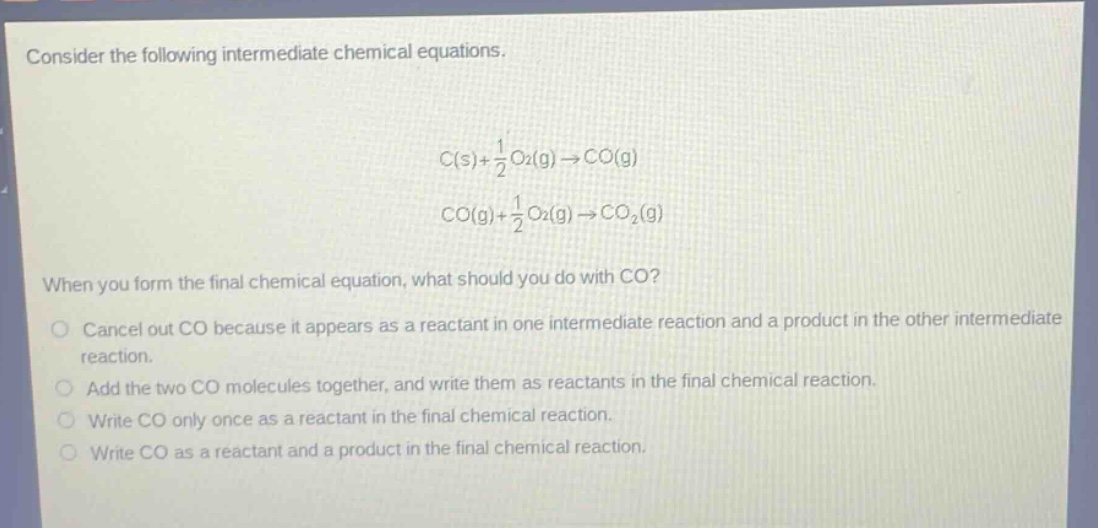
consider the following intermediate chemical equations. c(s)+1/2o2(g)→co(g) co(g)+1/2o2(g)→co2(g) when you form the final chemical equation, what should you do with co? cancel out co because it appears as a reactant in one intermediate reaction and a product in the other intermediate reaction. add the two co molecules together, and write them as reactants in the final chemical reaction. write co only once as a reactant in the final chemical reaction. write co as a reactant and a product in the final chemical reaction.
Answer
Answer:
A. Cancel out CO because it appears as a reactant in one intermediate reaction and a product in the other intermediate reaction.
Brief Explanations:
In chemical - equation combination, species that are products in one step and reactants in another are intermediates and are canceled out to get the overall reaction. Here, CO is an intermediate.