consider the following intermediate chemical equations.\nch4(g)+2o2(g)→co2(g)+2h2o(g)\n2h2o(g)→2h2o(l)\nwhich…
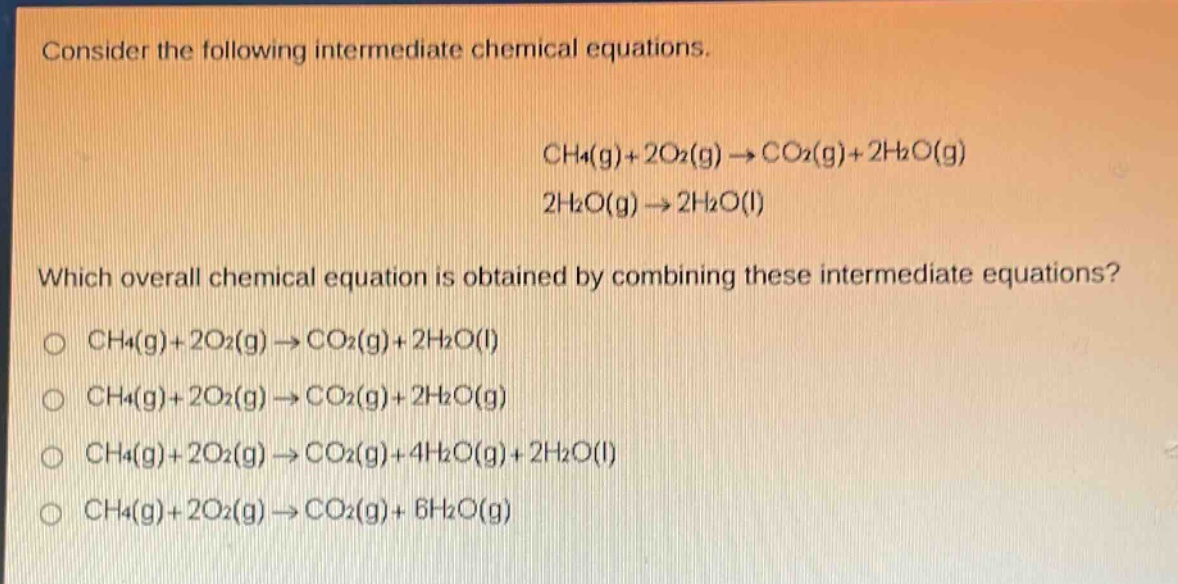
consider the following intermediate chemical equations.\nch4(g)+2o2(g)→co2(g)+2h2o(g)\n2h2o(g)→2h2o(l)\nwhich overall chemical equation is obtained by combining these intermediate equations?\no ch4(g)+2o2(g)→co2(g)+2h2o(l)\no ch4(g)+2o2(g)→co2(g)+2h2o(g)\no ch4(g)+2o2(g)→co2(g)+4h2o(g)+2h2o(l)\no ch4(g)+2o2(g)→co2(g)+6h2o(g)
Answer
Explanation:
Step1: Identify common species
The common species is $H_2O(g)$.
Step2: Combine equations
Add the two given equations. The first equation is $CH_4(g)+2O_2(g)\rightarrow CO_2(g)+2H_2O(g)$ and the second is $2H_2O(g)\rightarrow 2H_2O(l)$. When we add them, the $2H_2O(g)$ terms combine. The $2H_2O(g)$ on the right - hand side of the first equation and the $2H_2O(g)$ on the left - hand side of the second equation result in the overall equation $CH_4(g)+2O_2(g)\rightarrow CO_2(g)+2H_2O(l)$.
Answer:
$CH_4(g)+2O_2(g)\rightarrow CO_2(g)+2H_2O(l)$