consider the following intermediate chemical equations.\nc(s)+o₂(g)→co₂(g) δh₁ = -393.5kj\n2co(g)+o₂(g)→2co₂(…
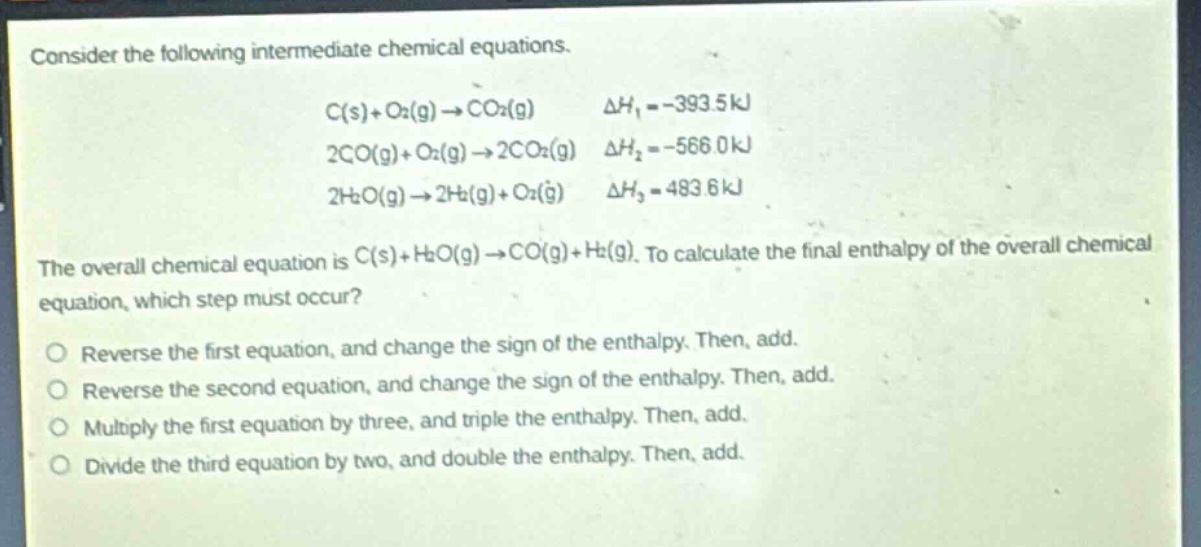
consider the following intermediate chemical equations.\nc(s)+o₂(g)→co₂(g) δh₁ = -393.5kj\n2co(g)+o₂(g)→2co₂(g) δh₂ = -566.0kj\n2h₂o(g)→2h₂(g)+o₂(g) δh₃ = 483.6kj\nthe overall chemical equation is c(s)+h₂o(g)→co(g)+h₂(g). to calculate the final enthalpy of the overall chemical equation, which step must occur?\nreverse the first equation, and change the sign of the enthalpy. then, add.\nreverse the second equation, and change the sign of the enthalpy. then, add.\nmultiply the first equation by three, and triple the enthalpy. then, add.\ndivide the third equation by two, and double the enthalpy. then, add.
Answer
Explanation:
Step1: Analyze the overall and intermediate equations
We want to get $C(s)+H_2O(g)\rightarrow CO(g)+H_2(g)$ from the given intermediate equations.
Step2: Analyze each option
- Option 1: Reversing $C(s)+O_2(g)\rightarrow CO_2(g)$ gives $CO_2(g)\rightarrow C(s)+O_2(g)$ with $\Delta H = 393.5$ kJ. This doesn't help in getting the overall equation.
- Option 2: Reverse the second equation $2CO(g)+O_2(g)\rightarrow 2CO_2(g)$ to $2CO_2(g)\rightarrow 2CO(g)+O_2(g)$ with $\Delta H = 566.0$ kJ.
- The first equation is $C(s)+O_2(g)\rightarrow CO_2(g)$ with $\Delta H_1=- 393.5$ kJ.
- The third equation is $2H_2O(g)\rightarrow 2H_2(g)+O_2(g)$ with $\Delta H_3 = 483.6$ kJ.
- Adding these three - modified equations:
- $C(s)+O_2(g)\rightarrow CO_2(g)$
- $2CO_2(g)\rightarrow 2CO(g)+O_2(g)$
- $2H_2O(g)\rightarrow 2H_2(g)+O_2(g)$
- After cancellation and simplification, we get $C(s)+H_2O(g)\rightarrow CO(g)+H_2(g)$.
- Option 3: Multiplying the first equation by three gives $3C(s)+3O_2(g)\rightarrow 3CO_2(g)$ with $\Delta H=-1180.5$ kJ. This doesn't lead to the overall equation.
- Option 4: Dividing the third equation by two gives $H_2O(g)\rightarrow H_2(g)+\frac{1}{2}O_2(g)$ with $\Delta H = 241.8$ kJ. This alone doesn't help in getting the overall equation.
Answer:
Reverse the second equation, and change the sign of the enthalpy. Then, add.