consider the following intermediate chemical equations. c(s)+1/2 o2(g)→co(g) co(g)+1/2 o2(g)→co2(g) when you…
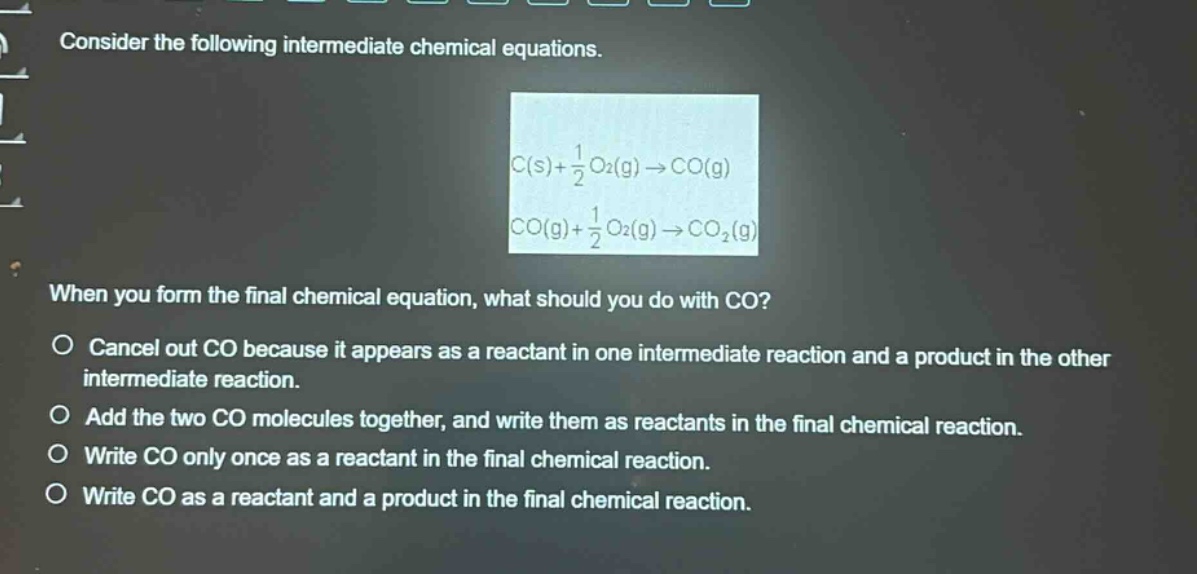
consider the following intermediate chemical equations. c(s)+1/2 o2(g)→co(g) co(g)+1/2 o2(g)→co2(g) when you form the final chemical equation, what should you do with co? cancel out co because it appears as a reactant in one intermediate reaction and a product in the other intermediate reaction. add the two co molecules together, and write them as reactants in the final chemical reaction. write co only once as a reactant in the final chemical reaction. write co as a reactant and a product in the final chemical reaction.
Answer
Brief Explanations:
In chemical reaction - mechanism, an intermediate species like CO which is produced in one step and consumed in another step gets cancelled out when writing the overall reaction. This is because it does not appear in the final balanced chemical equation for the overall process.
Answer:
Cancel out CO because it appears as a reactant in one intermediate reaction and a product in the other intermediate reaction.