consider the following intermediate chemical equations. c(s)+o2(g)→co2(g) δh1 = -393.5 kj 2co(g)+o2(g)→2co2(g…
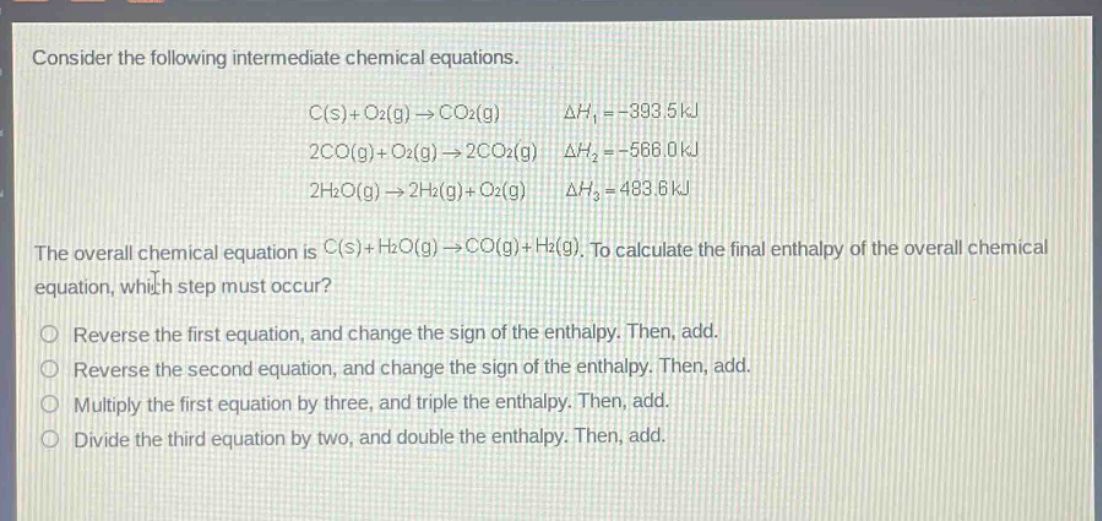
consider the following intermediate chemical equations. c(s)+o2(g)→co2(g) δh1 = -393.5 kj 2co(g)+o2(g)→2co2(g) δh2 = -566.0 kj 2h2o(g)→2h2(g)+o2(g) δh3 = 483.6 kj the overall chemical equation is c(s)+h2o(g)→co(g)+h2(g). to calculate the final enthalpy of the overall chemical equation, which step must occur? reverse the first equation, and change the sign of the enthalpy. then, add. reverse the second equation, and change the sign of the enthalpy. then, add. multiply the first equation by three, and triple the enthalpy. then, add. divide the third equation by two, and double the enthalpy. then, add.
Answer
Answer:
B. Reverse the second equation, and change the sign of the enthalpy. Then, add.
Explanation:
Step1: Analyze reactants and products
We have the overall reaction $C(s)+H_2O(g)\rightarrow CO(g)+H_2(g)$. The first - equation has $C(s)$ as a reactant which is correct as in the overall equation. The third - equation has $H_2O(g)$ as a reactant which is also correct. But the second equation has $CO$ as a product in its original form, while in the overall equation $CO$ is a product. So we need to reverse the second equation $2CO(g)+O_2(g)\rightarrow 2CO_2(g)$ to $2CO_2(g)\rightarrow 2CO(g)+O_2(g)$ and change the sign of $\Delta H_2$ from $\Delta H_2=- 566.0\ kJ$ to $\Delta H_2' = 566.0\ kJ$. After that, we can add the three equations to get the overall equation.