consider the following representation of a reaction mechanism.\nstep 1: a + a → c + e (slow)\nstep 2: e + b…
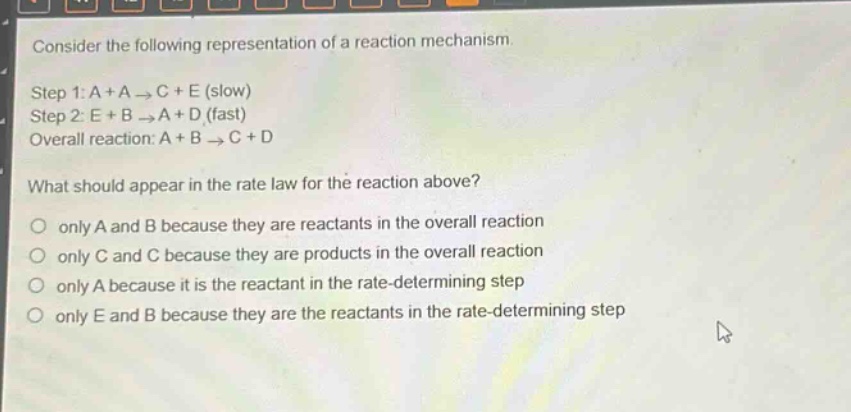
consider the following representation of a reaction mechanism.\nstep 1: a + a → c + e (slow)\nstep 2: e + b → a + d (fast)\noverall reaction: a + b → c + d\nwhat should appear in the rate law for the reaction above?\nonly a and b because they are reactants in the overall reaction\nonly c and c because they are products in the overall reaction\nonly a because it is the reactant in the rate - determining step\nonly e and b because they are the reactants in the rate - determining step
Answer
Answer:
C. only A because it is the reactant in the rate - determining step
Explanation:
Step1: Identify rate - determining step
The slow step (Step 1: $A + A\rightarrow C+E$) is the rate - determining step.
Step2: Determine rate law components
The rate of a reaction is determined by the rate - determining step. The rate law for the slow step depends only on the reactants of that step. Here, the reactant in the rate - determining step is A. So the rate law will involve only A.