consider the following system at equilibrium.\ncaco₃(s) ⇌ ca²⁺(aq) + co₃²⁻(aq)\nthe addition of which…
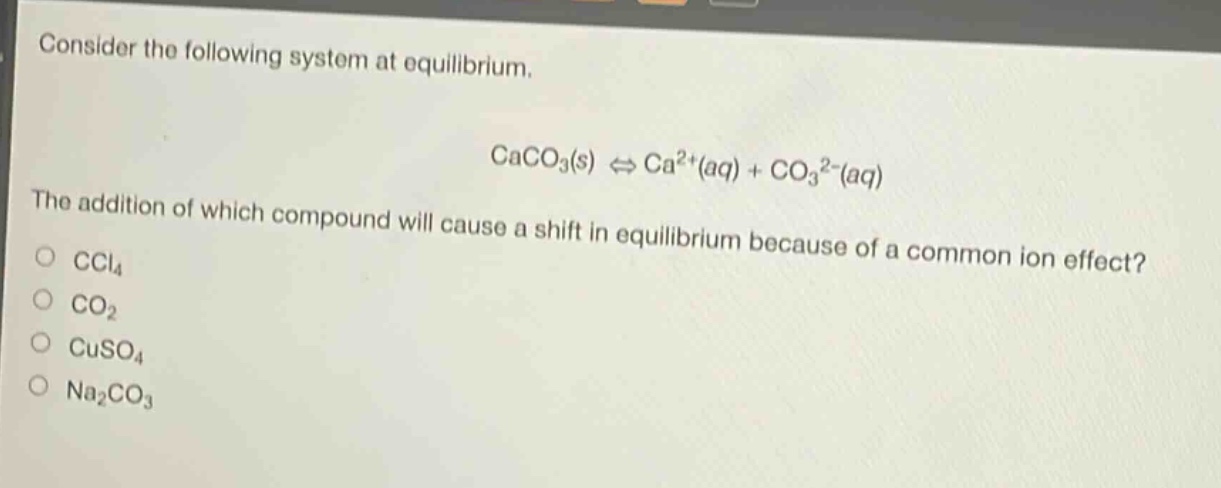
consider the following system at equilibrium.\ncaco₃(s) ⇌ ca²⁺(aq) + co₃²⁻(aq)\nthe addition of which compound will cause a shift in equilibrium because of a common - ion effect?\nccl₄\nco₂\ncuso₄\nna₂co₃
Answer
Explanation:
Step1: Understand common - ion effect
The common - ion effect occurs when an ion is added to a solution that already contains that ion, and it affects the equilibrium of a reaction. In the given equilibrium $CaCO_3(s)\rightleftharpoons Ca^{2 + }(aq)+CO_3^{2 - }(aq)$, we need to find a compound that will add either $Ca^{2+}$ or $CO_3^{2 - }$ ions.
Step2: Analyze each option
- $CCl_4$: It is a non - electrolyte and does not dissociate into ions in an aqueous solution, so it will not cause a common - ion effect.
- $CO_2$: It does not directly provide either $Ca^{2+}$ or $CO_3^{2 - }$ ions to the solution and will not cause a common - ion effect.
- $CuSO_4$: It dissociates into $Cu^{2+}$ and $SO_4^{2 - }$ ions. It does not have a common ion with the given equilibrium system, so it will not cause a common - ion effect.
- $Na_2CO_3$: It dissociates in solution as $Na_2CO_3(s)\rightarrow 2Na^{+}(aq)+CO_3^{2 - }(aq)$. It provides $CO_3^{2 - }$ ions which is a common ion in the equilibrium $CaCO_3(s)\rightleftharpoons Ca^{2 + }(aq)+CO_3^{2 - }(aq)$.
Answer:
D. $Na_2CO_3$